This video reveals 3 trends early adopters of AI in sales are uncovering while giving practical examples on how to incorporate AI-powered sales automation into your own comercial strategies.
Speaker 1 (08:37)
«In AI automation, the machine makes a decision and the human gets to execute some of the tasks. It’s a really big shift. Where it shows up the most is if you’re writing sequences, AI should be doing that for you. What used to take days or hours should now take minutes. If you’re personalizing an email, What used to take 20 to 30 minutes should now take 10 seconds to 2 minutes, depending on how much research you want to be involved in. This has been around for a couple of years. It’s the most basic of the trends, and it’s where we should be most furthest along. We see it most in content generation, whether we’re producing the entire sequence, specific steps of the sequence. But AI is here to assist us in a great way, doing the prospect research, doing the writing of the personalized communication, whether you’re in LinkedIn, you’re in email, or your sales engagement platform, it is here to work with you. That’s number one. Now, I’ll go through the three trends, then we’ll jump into a case study for each one to show you the payoff specifically that you should expect.
Transcription of the video:
«I am the co-founder of Reggie.ai. I’ve been selling since 1987, so that’s before email, before the internet. But one of the cool things about selling for this long is that, like you see technology coming to the sales tech stack. Yeah. You know, I saw the first laptops get into the hands of salespeople, the internet, the first mobile devices get into the hands of companies and sales organizations, the first sales engagement platforms. And every time you see these new technologies come into the sales, you see a step level increase in productivity. And that’s what’s super exciting.
And AI is no different. Like the infusion of AI right now should be a really exciting time for all of us because of the promise of the increase in productivity. So we’re going to jump into that and specifically the three trends that are driving that productivity right now. Ready to jump in, Dionne?
I am, Matt. I love everything you just said. There’s so much there. I think we could talk all day on that whole thing of new things coming in for sales and how do you get adoption and how do you get people to use it and how do you get your team to use it effectively? And they’re not necessarily stubbing their toe or the company’s reputation. There’s so much to say there. There is.
We’ll do as much as we can in 25 minutes. Let’s do it. Yeah.
So, you know, we jump in and one of the numbers that I’ve tracked for years is the percentage of sales reps (short form of sales representative) that hit their number. It’s called participation. And over the last like eight years, it’s gone down every single year, like 60% all the way down up until about a year ago, like in the high 40s, which means like less than half of the sales people are making their number.
But up until about a year ago, while this was going on, companies were still making their number. But this year is different. So this year, like companies are now missing. Companies are missing their pipeline generation numbers for the first time and rep participation is anywhere between 20 and 40%. Like we’ve got a pretty tough challenging year. We’re seeing like some pretty tough numbers.
So just know like that number has gone down to the point where it’s impacting companies and chief sales officers and revenue leaders, you know, really count on the outbound motion to generate pipelines. So like we got to figure this out quick. Yeah.
So what are the blockers? Like why is this happening? Well, first like leads, you know, I talked to some companies that got buckets of leads that aren’t being worked or reps don’t know which leads to work first over other leads or they’re not being worked effectively. Like they’re in sequences or cases that are stalled out because tasks aren’t getting executed. So there’s so many reasons where we’re just stalling out right at the leads, which is tough.
Second reason is technology. You know, you take a look, average company today spends over $5,000 per sales rep on technology. It doesn’t all work together, talk together. Reps don’t use it the same as inconsistent use. In many cases, reps aren’t using the technology, they’re given or not using it nearly to its potential. So there’s a lot of opportunity there to take advantage of the investment that organizations are making.
Next reason is the channel. I hear reps say, you know, email doesn’t work. Prospects don’t return my calls. My LinkedIn messages aren’t getting returned. Like channels aren’t working like they used to work. That’s partly true. I think the bar of excellence has certainly gotten higher to stand out and to be relevant today, but we have that.
And then lastly is what I call the talent rollercoaster where, you know, reps might not be in the seat long enough to really build up their book of business and to get the ramp behind them and get good motion or some jobs, you know, reps come in and want advancement too early and the organization’s not getting the return on the investment. And like, this was just a challenging year where reps weren’t winning and they might go look somewhere else where they think winning is easier. Whatever the reason though, you know, rep stability is important.
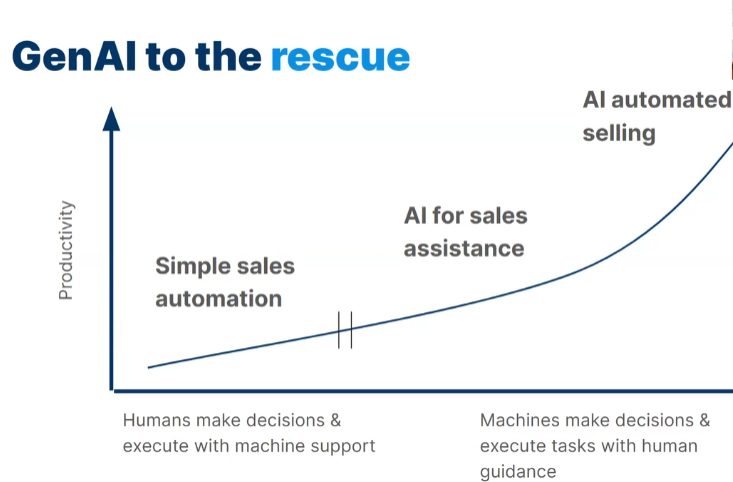
Oh, generative AI to the rescue. You know, tech has always been the promise. Like this next innovation of tech has always been, you know, the promise that will get us there. And one of the things that I’ve seen over the years is technology solves problems and technology creates problems. And up until AI, you know, rep participation hovered around that 50% mark even though there was more innovation every year, more technology available, reps weren’t necessarily winning more as a result.
And AI is here to change that. That will be different with AI and we’re gonna go into exactly why that’s the case. You know, I mentioned in my opening that every time we introduce technology, there is a step level increase in productivity. And here’s the payoff. Gardner did a study about 27% more benefit. I mean, that’s a really big number when you think about it.
And we’ll spend less time or no time on some administrative areas, more time in interacting with clients. And there’s a really great breakdown or transition of the, from your time to your time. But I would say on average, you should expect about a 30 year time to open up for the kind of tasks and activities that you would want your reps to spend that time on.
That is a big number, right? And that’s been the plight of salespeople for a long time, which is, do you want me doing admin work or do you want me selling, right? We want you selling. And that’s a fair question. So, yeah.
So AI is here. Now, depending on where you are in your AI journey, you may be successfully using this in your tech stack. You may be very skeptical somewhere on that continuum, but I’ll say AI is here.
AI has been here for years. It’s been here long before Chap GPT was here. In fact, we did AI before it was cool. We’ve been doing AI for over two and a half years now. But I will say, like G2 just did their state of the software survey and AI is fueling the software market, like twice as high as the next category. Like boom, thousand vendors in AI right now, thousand. Like there was just a handful a while back. There’s a thousand. It’s the fourth new category with most fire traffic and AI writing assistants are the second fastest growing category.
So AI is here. Like we just, and because it’s here, let’s jump in and understand like what it can do for us. What are the three big trends that we should be experiencing with the AI right now?
So first trend, this is the oldest of the three. I’m gonna go in chronological order. Oldest to newest, which is this notion of going from simple automation to AI automation. Simple automation is like your sales engagement platform where humans make the decision and the platform helps to execute some of the automated tasks.
In AI automation, the machine makes a decision and the human gets to execute some of the tasks. So it’s like, it’s a really big shift. So where it shows up like the most is if you’re writing sequences, AI should be doing that for you.
So what used to take days or hours should now take minutes. If you’re personalizing an email, now what used to take 20 to 30 minutes should now take 10 seconds to two minutes, depending on how much research you wanna be involved in. Like this has been around for a couple of years.
It’s the most basic of the trends and it’s where we should be most furthest along. And we see it most in content generation, whether we’re producing the entire sequence, specific steps of the sequence, but AI is here to assist us in a great way, doing the prospect research, doing the writing of the personalized communication, whether you’re in LinkedIn, you’re an email or your sales engagement platform, it is here to work with you. So that’s number one.
Now I’ll go through the three trends, then we’ll jump into a case study for each one to show you the payoff specifically that you should expect. Love that.
Trend number two, this one’s about a year old. So this is a little bit more recent and this is that prompts are replacing templates. Now, many of us know template emails and you can be using template emails in your cadences and sequences. You can be using template emails in one-off communication, but that can go away now, like W templates.
And in the same time that it took you to utilize a template, generative AI can now construct a unique piece of content for your prospect that’s personalized, it’s contextual, just as quick, much more impactful. So this is the big trend now. Now, the bigger question for me is who should do the prompting?
Yeah, that’s the question.
If you’re individuals going out to chat GPT, you’re using prompts, you’re going out, you’re using prompts, you’re bringing it, whatever it got back, doing some editing, figuring out how to use it and go, or you could be using a verticalized platform that’s preprompted with your brand voice, your personalization guidelines. It knows exactly where you are, what you’re doing in your workflow and will provide you sales ready content. So the real question is not whether do I use a template or prompts, but who’s doing the prompting? In some cases, reps are doing the prompting, in other cases, reps can be using a platform like Reggie that has all the prompting set up and it just delivers sales ready content right inside the workflow you’re in. But this is a big trend, it’s a little bit newer, getting about a year old.
Yeah. Yeah, so Matt, do you see organizations kind of going that route like you’re saying, because, and full disclosure, I love Reggie, I use it, you’re amazing. And so the question I have is, are you seeing organizations use Reggie and prompts in that way, which is like, because that was the big thing, right? Is organizations would say, I don’t want my sales people writing emails, I don’t want them doing X, right? We wanna be able to surface to your point sales ready content. So are you seeing organizations and marketing, product marketing, even maybe with a mix of sales people, kind of put together those lists of prompts, right? And so to kind of keep the guardrails and the messaging and the company voice and things of that nature, are you kind of seeing that as a best practice?
Yeah, that’s a really good question and I’ll go quickly. So like there’s four reasons you would wanna do it that way. Because the first way, like if reps are going out and doing this, there are no controls in place, it’s not respective of the company’s brand voice, it’s not specific to the persona, there’s no connected tissue to the marketing messaging or what they’re looking for.
Number two, you’re not getting sales ready, I’ll put that, you’re gonna have to do something with it and bring it back into your platform. The next piece is that your managers have no view of what you’re doing.
So one of the great attributes of sales tech is that managers have dashboards and visibility so they can help coach their reps. And if you’re just running out to chat or something else and doing your own prompting, you’re very much in asylum. So there’s a number of reasons that organizations move to a vertically oriented platform.
All right, let’s jump into the third trend because this is flying cars, this is like right now.
And this is the trend of going from content generation, which were the first two trends that we talked about, where the generative AI is actually doing task execution. It’s doing tasks for us.
And because this is brand new, like literally like happening as we speak, I’m gonna spend a bit more time on this one before I go into case study. So we call these agents, AI agents, and these are basically AI programs that do work for us, very specific bodies of work. And we have eight predominant use cases.
They can do cold outbound, we’ll walk through a use case. They can do your LinkedIn connection requests. They can respond to inbound. They can do sales nurture. If you’re doing account-based sales where you’re multithreading, they can support that, customer expansion. Some companies outsource leads to third-party partners.
Agents can do all that work in-house much more cost-effectively, higher quality. And then we have what we call outbound and inbound. So those lower priority leads that come in through inbound, not really leads, but they’re interacting.
Like what do you do with them? You can put an agent. So there’s all these really pragmatic use cases where agents can come in. We’ll go a little bit deeper.
So one of them is audience expansion, or list building. I talked about this as like one of the big blockers. But what our agent can do is go into your Salesforce. It can take a look at where you’re winning, the kind of company and the different personas that you’re interacting with, and then build a lookalike list using your lead list.
And then beyond that, we’ll go to your data provider and find additional prospects for you to go after to expand your audience of prospects. And it’ll do this 24 seven in the background.
We continually go out and look for prospects that match where you’re winning, and then automatically start to communicate to them. And it’ll do it just like this. So I find Dion. Dion’s exactly the kind of person I’d love to sell to. And what the platform will do, it’ll write a contextual personalized email to Dion based on the prompting that we want, the brand voice of my company, her prospect, what I want to personalize around, whether it’s a Salesforce field, some intent data, whatever it may be. And then based on her response, I’ll either start to create high priority tasks for the rep to reach out, or we’ll provide her some information if she’s a little bit of bilateral but interested, or if there’s no interest, instead of putting her through 17 steps or 24 days, we’ll just drop her right into Nurture.
All with no rep interaction. So we’re gonna find the list, build the list, start to talk to the list. And when the list becomes engaged, then we serve up those tasks to the rep. And this is happening right now. You think about all the manual work that we’re eliminating. And I think for me, what’s most exciting is that we’re seeing prospect sentiment go up.
Because prospects are getting more relevant messaging. The ones that want to engage are getting it even quicker. The ones that don’t want it aren’t getting pummeled.
And then reps are only working tasks on prospects that are looking for engagement. So super excited about this one. So what I’m gonna do is I’m gonna jump into a few case studies here. Please do.
And really what I’m gonna do is I’m gonna highlight the payoff of what you should be seeing from the AI. Yes.
So first, we go back to trend one. This is a couple of years old. And this is where we let the machine make the decisions largely around content generations.
And our first case study is reputation. It’s on our website as well. And they used to write all their sequences by hand. Personalization was all manual. So this was, we did bias. We use our bias and experience, our habits.
And we started relying on Reggie to write the sequences. So it used to take days, brought it down to minutes. And we could start to provide better analytics around what they were building that allowed you to iterate and optimize your messaging over time. So here’s the payoff.
Wow.
This payoff, first we were saving over $100 a month of somebody’s time in content generation. So that’s a big chunk of time. But here’s where I get excited, which is positive email reply went from 35 to 48%. Like you think about, there’s no spam cannon here.
Like this is good. And then opens went from 52 to 66, seven and reply went from 4.8 to 7%. So like one, like we can save a bunch of time and two, like we’re driving better engagement for the team and we’re driving happier prospects in the process.
Super important. That is really important, Matt. And we always, and you and I have probably talked about this, right? Where we live in an age of zero surprises, zero.
I can track my Amazon, my packages, right? All that good stuff. And that consumer experience is now expected in the buyer side, right? In the B2B side of the world where it’s like, hey, there’s enough data out there in the United States and laws are different. Privacy is dead. Get your technology working to meet me where I am. And I think, I don’t have any science behind that, right? But if I’m saying it and feeling it you’re probably seeing it anecdotally. It’s one of those things where it’s like that is kind of the expectation now for people. Thoughts on that?
Yeah, I mean, I think the big thing is if you’re gonna interrupt somebody in their day you’ve gotta be relevant to them. Well said. And what we can show here is that we can increase personalization and relevancy at every touch.
Yep, yep. Yeah, and I love that overarching thought process, right? Just kind of having that first, keep the first thing first, right? Just if you’re gonna interrupt, be relevant. And if they keep going, great. And if not, then nicely, delicately back away. Let everybody have their dignity and don’t be a jerk about it, right? Yep. Love that.Love it.
Cool. All right, number two.
This was going from templates to prompting, right? And smartly, again, new case study on the website. Same thing, we’re gonna rely on the machine to figure this out. So the before, they were challenged with the CEO wanting more volume, the CRO wanting more personalization.
And we’re able to balance that off and achieve that with the AI because it would be humanly impossible to do it without the assistance of the machine. So what did we get?
Well, the first thing we did was inside of Reggie we built out 20 persona profiles so Reggie knew who we were selling to. And because of that, the minute that prospect name came up inside of Outreach or Salesforce or LinkedIn, wherever you are, email, Reggie automatically knows who the prospect is, matches it to the persona, the persona is matched to your company messaging for that persona, it’s got your brand voice, it’s got your personalization guidelines. And as a result, 72% of all the emails are personalized in under one minute. Wow. And I can’t tell you how many companies I talked to, oh, we do 50 personal emails a day.
Well, if the average email takes 20 minutes to research, personalize and write, you’re not doing 50 of those a day. And the first ones are better, the last ones are sloppy. You know, like the law of diminishing greatness.
And here, like Reggie consistently can do it in seconds. There’s three different workflows for it. But we’re able to achieve both.
And this is here, like this is available right now. Again, if your team is doing any of this manually, like there is a better way. When I say better, like you can go better faster.
All right, let’s jump into the first one. Third. So this is where we’re going from content generation to task execution.
I’m gonna use my company as the example. You know, before my team was constrained in outbound activity based on the size of my team. Like we could only do so many manual tasks in a day because we’re very process driven. We’re gonna complete all of our tasks every day. And there’s only so much time. You know, even with automation on the emails, you know, there’s still phone calls. There’s still things that you have to do that take time. So we actually created an agent.
We have a series of agents that do everything from prospecting, lead sourcing, content generation, our task management.
All of this is going on in the background for my team. So let me talk about the results here. Yeah.
Because this is super exciting. The first thing with our audience expansion module, which I talked through, we were able to find 9,000 contacts that we weren’t aware of.
Wow.
So it expanded our audience of who we can sell to. Then the agent started automatically communicating with those 9,000 contacts. And over the last five weeks has generated over 3,000 high priority tasks for my team to follow up on, like engage prospects.
Wow. And right now the agent, in the agent initiated leads, account for about 28% of all the meetings we’re setting. It’s phenomenal.
So it’s here. Like I just like agents are here, flying cars are here. AIs.
Agents and flying cars, 100%. That’s amazing. Matt, what was the timeframe for this case study? Well, this is ongoing. So this is over now the last five weeks. Okay. And we continue to load up the agents and find additional use cases for agents ourselves.
Yeah. Yeah. I mean, for five weeks, that’s a pretty impactful, those are impactful numbers, right? To your point and the numbers earlier where outbound is still a thing, but to your point, there’s a better way to do it that is still high quality.
Right. And I’m glad you said high quality because when we think about these agents, you’re curious like what kind of content are these agents putting forward on my brand’s behalf? And these are like responses we’re getting to agent generating communications, to agent generating prospects. This is such a good email, like get me a demo, curious to learn more.
Like these are literally responses coming back and these agents map every prospect to a sales reps inbox. So as this prospect responds back, it comes right into one of my reps to follow up on.
Yeah.
So it’s great. That is. So let’s do this.
Let’s kind of finish where we started. We talked about the blockers and in the last 25 minutes, like we’ve solved these for success. So number one, we talked about, you know, like list building was a problem.
Now it’s easy for us to do this in a great way without bogging down RevOps or our sales team. We can unify our tech stack. Like agents can bring all the signals in from your CRM, your intent provider, your sales engagement platform.
The agents can work with all of your existing tech to optimize the engagement. And it does it by serving up the right message to the right prospect with the right channel at the right time, automatically. Like we’re solving for this as we go.
And this results in happier prospects, happier reps, like everybody’s a little bit happier and driving more success into the organization. So let me leave you with a little bit of advice, like three things. So like one, trust the AI.
Now I remember my first year selling what we’re selling about two and a half years ago, we spent the first year talking to customers about trusting what the AI is doing. We’re far beyond that now. Like we’ve all had our experience somewhere where the AI is living and our Microsoft apps, it’s all over the place now.
So like we should just trust it. Like it’s not going anywhere. I think the bigger piece is we should start to experiment with it.
Where can we start using the AI based on our workflow, our messaging, our brand, like how we want to do business, figure out how much, how little AI makes sense to augment your team and help drive that productivity level. And then third is my favorite, like tech is a teammate. And really it’s like, where do you draw the line where the tech hands off to the team? And we’ve seen a number of examples where the companies would offshore customer support, customers complain that we short, or you mentioned Amazon.
Well, you might not like dealing with a bot on a bottle of water. So like you’re gonna have to make like a decision of your brand and how much you humanize all the different experiences and use that to gauge where AI hands off to humans.
Yeah, I think that’s a really good point, Matt. I think sometimes we kind of throw things over the proverbial fence, right? And so I think to your point of having it be a teammate and as a human, for now, at least we’re still in charge, right, until the AI takes over, right? That’s a joke, but yes, for now we are as humans still in charge of technology because it does have to tell, it does have to do what we tell it to do. So I love everything you’re talking about here. And I love that, starting with the trust and move on, the toothpaste is already out of the proverbial too, right? So figure out how to use the AI to get better, be better and meet your customers where they’re at, happier customers and happier teammates. And just, it allows for a really good blending of the qualitative and quantitative at the end of the day, that work-life balance that people are really hungry for. And as a business owner, right, we have that fiduciary responsibility to make sure we make numbers too, right? So it’s a good balance. Yeah. It’s a good balance, I like it. All right, let’s talk about what we got for everybody.
All right, well, first, if you want to stay in touch, love to continue the conversation.
You can find me on LinkedIn, best place. We’ve got a couple of gifts that we’re super happy. So number one, everybody is going to receive a definitive guide to AI and sales.
So we’ve got the original book we published and we’re also refreshing it full of agent data. Everybody will get a promo code for a free license of Reggie. Thank you, that’s very generous, we love that.
Yeah, so we’ve got gifts. Yeah, we like gifts. It’s the holiday giving season, we’re coming up to it, right? So thank you, Matt, and from you and from Reggie to give those gifts out to everybody.
It’s really important, like you said, for people that are maybe a little behind on embracing some of these things, this is a really great way to really dive in and start using the technology.»
©image. http://www.regie.ai/
 @Yolanda Muriel

 yolandamuriel.com