Introduction
This article presents a concise synthesis of the study La adaptación del chino al MCER en España: un análisis crítico, published in Inter Asia Papers (ISSN 2013-1747, No. 61, 2018) by Helena Casas-Tost and Sara Rovira-Esteva (Universitat Autònoma de Barcelona). The original study offers a rigorous critical examination of how the Common European Framework of Reference for Languages (CEFR) has been applied to the teaching and assessment of Chinese as a foreign language in Spain, highlighting structural mismatches, unrealistic proficiency expectations, and conceptual distortions derived from the imposition of a rigid European standard on a typologically distant language.
Building on this analysis, the present article moves beyond diagnosis to reflection. It explores the emerging space for open-source large language models (LLMs) as a viable alternative—or at least a corrective—to traditional, level-based frameworks. Unlike static curricular models, LLM-driven approaches enable adaptive, data-informed learning paths that can better accommodate the non-linear development of Chinese language competence, particularly in areas such as listening comprehension, lexical acquisition, and pragmatic usage.
Finally, the article illustrates this shift through a practical example of a text-based learning model, demonstrating how AI-supported resources can be used to facilitate Chinese language learning in a more flexible, learner-centered, and linguistically grounded manner. In doing so, the paper argues for a transition from rigid standardization toward dynamic, technology-enhanced pedagogical frameworks that are better aligned with both the nature of the Chinese language and the realities of contemporary learners.
In the following link, you can find the study La adaptación del chino al MCER en España: un análisis crítico, published in Inter Asia Papers (ISSN 2013-1747, No. 61, 2018):
Haz clic para acceder a intasipap_a2018n61.pdf
La adaptación del chino al MCER en España: un análisis crítico.
Summarize.
Over the past decade, language education in Europe has undergone a paradigm shift driven by the Common European Framework of Reference for Languages (CEFR). Although originally designed for European languages, the CEFR has been applied indiscriminately to non-European languages, including Chinese. In Spain, this adaptation has often been rigid and uncritical, failing to account for the structural and cultural specificities of Chinese and, in some cases, leading to distorted curricular representations. Moreover, the unreflective transfer of a European model has contributed to the persistence of erroneous and even orientalist discourses about the Chinese language. Against the backdrop of the growing presence of Chinese in Spanish educational institutions, this study calls for a critical reassessment of the CEFR’s application to Chinese and questions the assumption of its universal validity without substantial adjustment.
Adaptation of Chinese to the CEFR in Spain
This section of the work examines the application of the CEFR to Chinese by reviewing both Spanish and Chinese-language contexts. In Spain, it analyses Chinese language curricula in Official Language Schools and university degree programmes, based on publicly available documentation. In parallel, it surveys published CEFR-related proposals developed in China and Taiwan. The section concludes by referencing a collaborative European initiative, the European Benchmark Framework for Chinese, aimed at establishing common reference standards for Chinese language proficiency.
In Spain, Official Language Schools have aligned Chinese language curricula and certification with the CEFR, particularly following successive national decrees. However, since curricular content and sequencing are defined at the regional level, significant disparities persist across Autonomous Communities, resulting in uneven training durations to reach the same B2-level certification.
The study shows this table:
| Centro | Años de estudio | Nivel MCER |
|---|---|---|
| EOI d’Alacant | 6 | B2 |
| EOI da Coruña | 6 | B1 |
| EOI de Barcelona Drassanes | 6 | B2 |
| EOI de Castelló | 6 | B2 |
| EOI de Lugo | 6 | B2 |
| EOI de Madrid Jesús Maestro | 8 | B2 |
| EOI de Málaga | 5 | B2 |
| EOI de Murcia | 8 | B2 |
| EOI de Ourense | 6 | B2 |
| EOI de Palma | 7 | B2 |
| EOI de Segovia | 8 | B2 |
| EOI de Valencia | 6 | B2 |
| EOI de Valladolid | 8 | B2 |
| EOI de Vigo | 6 | B1 |
Although educational policies generally expect learners to attain at least a B2 level in all languages, Chinese is treated differently only through the addition of extra courses to accommodate its non-Latin writing system. However, this adjustment is insufficient to ensure comparable proficiency across all skills in typologically distant languages such as English and Chinese.
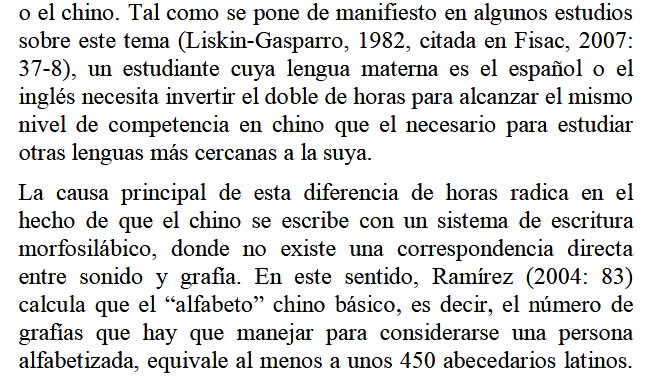
Research indicates that Spanish- or English-speaking learners require approximately twice as many instructional hours to reach equivalent competence in Chinese, primarily due to its morphosyllabic writing system and the absence of a direct sound–grapheme correspondence.
As literacy in Chinese entails mastering a vastly larger set of graphic units, writing effectively functions as an additional skill, slowing overall progress. Studies further show that reducing reliance on characters or combining them with an alphabetic system such as pinyin significantly accelerates learning, highlighting a linguistic specificity that is often underestimated in curricular design.
As the authors of the study explains:

Influence of the CEFR in the Chinese Context
The publication of the CEFR has also impacted China, affecting both the teaching of foreign languages other than Chinese and Chinese as a foreign language. This influence extends to official exams that certify specific language proficiency levels. Below, the most significant initiatives are presented.
Although the Confucius Institute Headquarters (Hanban) establishes equivalences between the new HSK levels, the five levels of the Chinese Language Proficiency Scales for Speakers of Other Languages (Hanban, 2007), and the six CEFR levels, notable mismatches remain. For instance, HSK Level 3—requiring mastery of 600 words—is equated with CEFR B1 and Level 3 of the Chinese Language Proficiency Scales, which requires 900 words.
A more realistic framework from Taiwan’s Steering Committee for the Test of Proficiency (SC-TOP) defines four levels: beginner (800 words, A2), basic (1,500 words, B1), intermediate (5,000 words, B2), and advanced (8,000 words, C1), aligning more closely with the requirements of European languages.
European Benchmark Framework for Chinese (EBCL)
The European Benchmarks for the Chinese Language (EBCL) was a European Commission‑funded project (2010–2012) aimed at creating a benchmark framework for Chinese as a foreign language based on the CEFR. Its purpose was to provide can‑do descriptors, thematic structures, and character/word lists for Chinese proficiency levels, specifically for learners in Europe, aligned with CEFR principles. The project produced benchmarks mainly for beginner levels (A1 to A2+), including task examples and vocabulary/character targets, to support standardized teaching, learning, and assessment of Chinese across European educational contexts. The EBCL framework helps fill gaps left by applying the CEFR, originally designed for alphabetic European languages, to Chinese’s unique linguistic features.
Analysis of Specific CEFR Implementation Proposals for Chinese in Spain
Detailed analysis shows that these frameworks sometimes misrepresent Chinese’s internal organization, creating terminological and conceptual inconsistencies by privileging non-Chinese terminology and attributing categories and features that do not naturally apply. The following discussion identifies areas for future improvement:
a) Appropriateness of Content Allocation Across Proficiency Levels
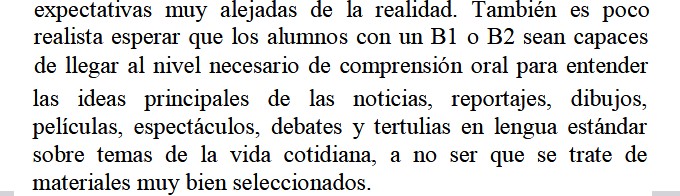
Several curricular contents appear to exceed learners’ actual capabilities at the levels at which they are introduced. At the basic level, it is unrealistic to expect students to master proverbs, idiomatic expressions, and quotations, to differentiate between a wide range of registers (solemn, formal, neutral, informal, familiar, and intimate), or to identify linguistic markers of geographical, professional, social, and generational variation.
Similarly, expecting B1 or B2 learners to attain sufficient listening comprehension to grasp the main ideas of news reports, films, performances, debates, or discussions in standard Chinese on everyday topics is unrealistic. Moreover, requiring learners to recognize vulgar language, frequent swear words, or professional registers is questionable, given that current curricula aim to provide general rather than purpose-specific training. Such abilities typically presuppose a high level of linguistic specialization, including sensitivity to phonetic variation and articulatory reduction in colloquial speech. Finally, the stylistic and figurative use of deliberately “inappropriate” classifiers or measure words in literary, journalistic, and advertising registers represents knowledge that even many native speakers lack and therefore should not be included as learning objectives for B2-level programs.
The authors of the study explains:
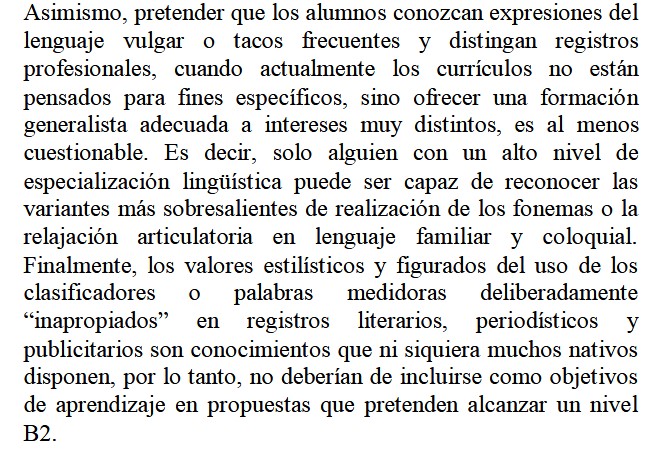
And as a conclusion of this issues, the authors of the study explains:

According to this study, and as a one of the crucial conclusions is that one of the central limitations of the CEFR in its application to Chinese lies in the absence of explicit minimum lexical thresholds for each proficiency level. Unlike languages where grammatical complexity and cognates may compensate for limited vocabulary, Chinese relies heavily on lexical breadth for effective communication. As a result, assessing proficiency without clearly defined vocabulary benchmarks makes reliable evaluation particularly difficult.
This gap leads to systematic inconsistencies in assessment. A learner may demonstrate fluent pronunciation, accurate syntax, and pragmatic appropriateness, yet operate with a limited lexical repertoire comparable to an A2 level, while being evaluated under B2 criteria. Conversely, another learner may possess the lexical range typically associated with B2 (number of words), enabling comprehension of more complex texts, but lack fluency, automaticity, or confidence in spoken production. In such cases, evaluation becomes highly subjective, often favoring surface fluency over lexical depth or, alternatively, penalizing hesitation despite stronger underlying competence.
The absence of lexical benchmarks (number of words) therefore undermines the reliability and comparability of CEFR-based assessment in Chinese. Without accounting for vocabulary size as a core dimension of proficiency, the framework risks conflating fluency with competence and obscuring meaningful differences in learners’ actual communicative capacity. This structural weakness highlights the need for more language-specific, data-informed assessment models capable of capturing both lexical knowledge and communicative performance in a balanced and objective manner.
From Standardization to Adaptive Learning: Connecting Current Challenges in Chinese Language Education with LMS-Based Frameworks
The critical overview of the current state of Chinese language learning highlights a structural tension between the rigid application of the CEFR and the linguistic, cognitive, and pedagogical realities of Chinese as a foreign language. According to the study of the analysis of Spanish implementations we have previously seen, the attempt to impose uniform European descriptors often results in artificial curricular structures, inflated proficiency expectations, and misaligned learning outcomes. Also the previous study argues that rather than reflecting authentic communicative development, these frameworks tend to prioritize formal compliance with predefined levels over learners’ actual abilities and learning trajectories.
In this context, the LMS-based curriculum framework discussed in the present document may offers a pragmatic response to these limitations. By shifting the focus from static level descriptors to competency-based, outcome-oriented learning, LMS-supported models introduce flexibility instead of standardization. Blended learning environments enable continuous access to materials, iterative practice, and individualized pacing—elements that are largely absent from traditional CEFR-driven classroom models. Importantly, this approach acknowledges that proficiency in Chinese does not develop linearly or uniformly across skills, particularly in listening comprehension and pragmatic competence, areas repeatedly identified as problematic in CEFR-aligned curricula.
Moreover, the integration of multiple reference frameworks (CEFR, EBCL, TOCFL, HSK 3.0) within an LMS ecosystem may reflects a post-standard paradigm in language education. Instead of treating any single framework as normative, the curriculum selectively draws on each model according to its strengths, thereby mitigating the distortions that arise when Chinese is forced into a monolithic European standard. This plural and modular approach aligns more closely with the realities of contemporary learners and institutional constraints.
Crucially, LMS-based instruction also anticipates a broader transformation in language education: the transition from fixed curricular models to data-informed, adaptive systems. The analytics, automation, and scalability inherent in LMS platforms lay the groundwork for more advanced applications of artificial intelligence and open-source large language models (LLMs). Where the CEFR relies on abstract descriptors and idealized learner profiles, AI-driven systems can analyze real learner output, interaction patterns, and developmental sequences, enabling a more empirical and dynamic understanding of proficiency.
Thus, the LMS framework presented here may should not be seen merely as a technological upgrade, but as an intermediate stage in a necessary paradigm shift. It addresses the shortcomings identified in the current application of the CEFR to Chinese while opening the door to AI-enhanced, learner-centered models capable of overcoming the structural rigidity that has long constrained Chinese language education.
As the authors of the study claim, a further limitation of the CEFR, particularly relevant in the context of Chinese as a foreign language, is that lexical scope is not explicitly addressed (number of words), nor are alternative measures provided to approximate vocabulary development across proficiency levels. As a result, curricular design and assessment often proceed without clear reference points regarding learners’ evolving lexical resources. This omission is especially noticeable in Chinese, where vocabulary growth is closely intertwined with character recognition and the acquisition of recurring lexical patterns.
In this respect, large language models (LLMs) could be used as analytical tools to examine learner language data at scale—for example, by analysing written assignments or oral transcripts to identify the range and recurrence of lexical items used at different stages of instruction. Such analyses would not aim to impose fixed vocabulary targets, but rather to observe and describe how lexical repertoires tend to expand in relation to communicative tasks and learning outcomes.
Practical example of a text-based learning model.
Demonstrating how AI-supported resources can be used to facilitate Chinese language learning in a more flexible, learner-centered, and linguistically grounded manner. In doing so, the paper argues for a transition from standardization toward may dynamic, technology-enhanced pedagogical frameworks that may are better aligned with both the nature of the Chinese language and the realities of contemporary learners.
Teaching materials for Chinese should reflect its fundamentally phonological nature by integrating sound, text and meaning. The systematic inclusion of pinyin—especially at beginner and intermediate levels—helps counter the persistent ideographic myth and supports the development of oral competence. Rather than being removed dogmatically, pinyin should be used strategically and progressively withdrawn as learners gain phonological and lexical autonomy.
Teaching materials for Chinese should be designed on the assumption that Chinese is a fully-fledged natural language whose written form represents spoken language, rather than an autonomous system of visual symbols. This implies that instructional texts must not privilege characters as isolated carriers of meaning, but instead integrate them into a broader communicative framework where sound, meaning and usage are inseparable.
Consequently, learning materials should systematically connect written texts with authentic or semi-authentic audio input, allowing learners to access meaning through pronunciation and prosody. Such an approach reflects the linguistic reality of Chinese, in which lexical meaning is accessed via phonological forms, despite the non-alphabetic nature of the writing system.
Moreover, texts should be constructed to reveal internal regularities of the language, including phonetic patterns and lexical families, rather than encouraging rote memorisation of characters. By highlighting these regularities, learners develop predictive strategies and linguistic awareness, which are essential at higher proficiency levels.
Finally, text selection and progression should be guided primarily by communicative competence rather than by graphic simplicity. At B2 and above, learners should engage with texts that reflect real discourse practices, even if they contain complex characters, provided that adequate phonological and contextual support is offered during the learning process.
Learning objective
- Develop advanced reading comprehension
- Strengthen listening–reading integration
- Consolidate vocabulary related to abstract topics (e.g. work, society, technology)
Step 1: Audio-first exposure (no text visible)
Learners first listen to a short audio recording (1–2 minutes) spoken at near-natural speed.
Step 2: Text with characters + selective pinyin (guided study version)
Characters with pinyin support for less frequent or potentially ambiguous items only
随着远程工作的普及,越来越多的年轻人开始重新思考工作的意义。
随着 (suízhe) 远程工作的普及,越来越多的年轻人开始重新思考工作的意义。
他们不再只关注收入,而是更加重视工作的灵活性、个人发展以及生活的整体质量。
这种变化不仅影响了个人的职业选择,也正在逐步改变企业的组织结构。
Step 3: Vocabulary and phonological awareness
| Word | Characters | Pinyin | Note |
|---|---|---|---|
| prevalence | 普及 | pǔjí | Common in formal written discourse |
| flexibility | 灵活性 | línghuóxìng | Derived abstract noun |
| organisational structure | 组织结构 | zǔzhī jiégòu | Frequent in academic texts |
Step 4: Listening–reading integration task
- Listen again while reading the text without pinyin
- Mark stress patterns and pauses
- Notice how discourse markers are realised prosodically
Step 5: Advanced learner version (characters only)
随着远程工作的普及,越来越多的年轻人开始重新思考工作的意义。
他们不再只关注收入,而是更加重视工作的灵活性、个人发展以及生活的整体质量。
这种变化不仅影响了个人的职业选择,也正在逐步改变企业的组织结构。
At upper-intermediate and advanced levels, Chinese teaching materials should prioritise discourse-level competence and sound–meaning integration. Rather than eliminating pinyin dogmatically, it should be used selectively as a pedagogical tool, supporting phonological awareness while allowing learners to transition towards character-only literacy.

 @Yolanda Muriel

 yolandamuriel.com