The article explains the concept of Transfer Learning in machine learning. Instead of training a deep neural network from the beginning, transfer learning suggests reusing a model that has already been trained on another task and adapting it to a new one.
Rather than building a model from scratch, you take a network trained on a different domain, then you adapt it to your own problem.
© Image. Kevin McGuinness
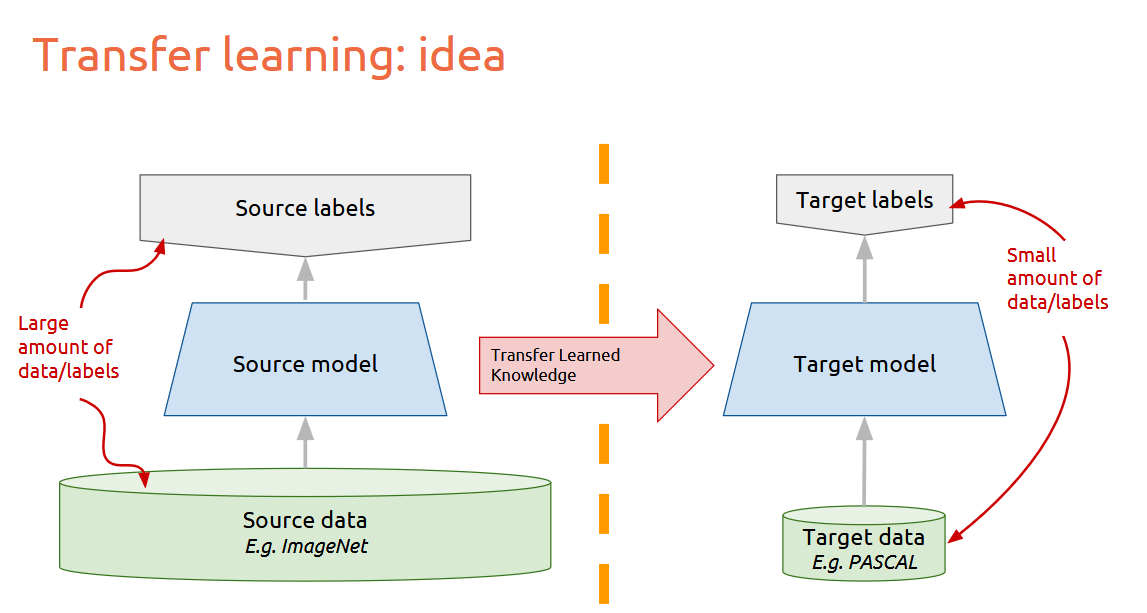
(Source domain/task):
For example, ImageNet, a large dataset with thousands of diverse images. This represents the original training domain, where a model has already learned general visual features (edges, shapes, textures, objects).
Center arrow: A red arrow labeled “Transfer Learned Knowledge”. This symbolizes moving the learned knowledge from the source model to a new task.
(Target domain/task):
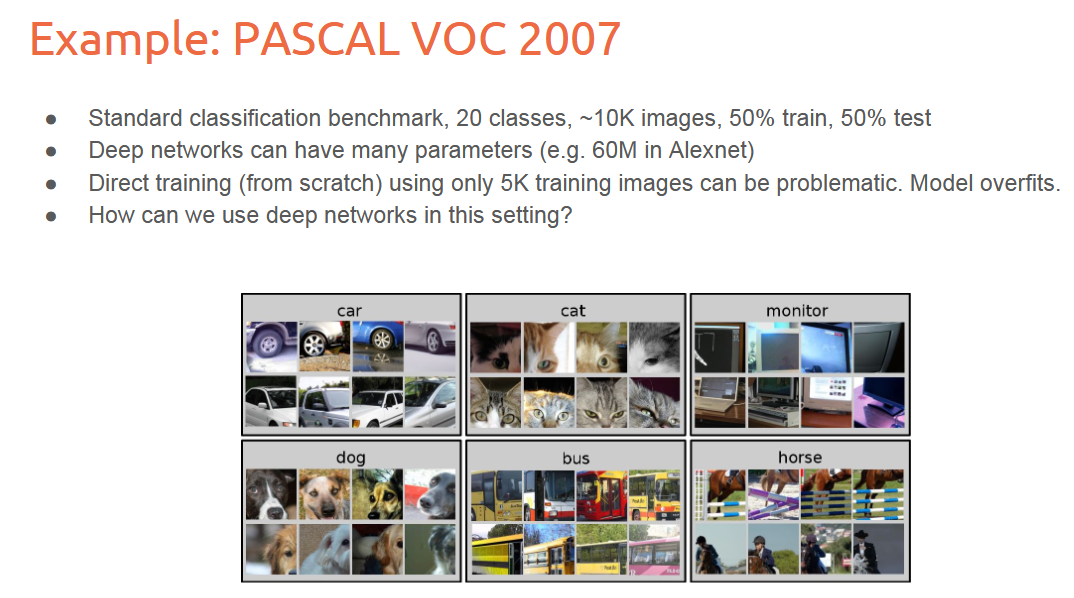
The image shows PASCAL VOC dataset with categories like:
-
-
- car
- cat
- monitor
- dog
- bus
- horse
-
© Image. https://imatge-upc.github.io/telecombcn-2016-dlcv/slides/D2L5-transfer.pdf
This represents the new task, usually smaller or more specific.
The diagram illustrates that:
- A model trained on a large dataset (ImageNet) learns useful general features.
- These features can be reused and fine-tuned for a different but related task (like classifying specific objects in PASCAL).
- This approach saves time, reduces required data, and often improves performance.
Conclusion
Transfer learning allows you to reuse knowledge learned in one problem to solve another problem more efficiently, instead of starting from zero.
References:
DEEP LEARNING FOR COMPUTER VISION. SUMMER SEMINAR UPC TELECOM BCN
 @Yolanda Muriel

 yolandamuriel.com