Recurrent Neural Networks (RNNs) are designed to process sequences, such as text or audio. They read data step by step and keep a memory of what they have seen so far. Depending on the task, RNNs can be uni‑directional or bi‑directional.
Understanding when to use each type is essential for building correct and reliable models.
What Is Language Modeling?
Language Modeling is the task of predicting the next token (character or word) in a sequence, given only the previous tokens.
Simple example:
If the model sees:
“I like to drink”
It must predict the next word, such as:
“coffee”
The key idea is that:
The model can only use the past and he future words do not exist yet at prediction time. This is known as a causal or left‑to‑right process.
How a Uni‑Directional RNN Works in Language Modeling
A uni‑directional RNN processes the sequence from left to right, one token at a time:
“I” » “like” » “to” » “drink” » ?
At each step:
The RNN uses past context only. This perfectly matches how text is generated in real life. Also This makes uni‑directional RNNs suitable for language modeling.
What Is a Bidirectional RNN?
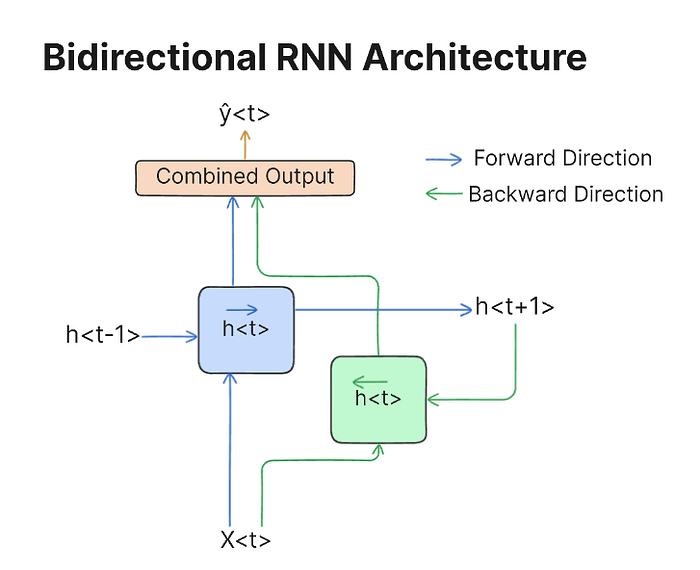
A bidirectional RNN has two passes:
- One RNN reads the sequence forward
- Another RNN reads the sequence backward
The outputs are combined so that each position sees both past and future context. This sounds powerful—but it creates a problem for language modeling.
Why Bidirectional RNNs Should NOT Be Used for Language Modeling
The core issue: future information leakage
In language modeling:
The model is asked to predict a token before it appears and a bidirectional RNN would already have access to future tokens. That means the model would be “cheating”.
Example:
If the full sentence is:
“I like to drink coffee”
A bidirectional RNN predicting “coffee” would already have seen:
- “coffee” from the backward pass
This violates the causal nature of language modeling.
Why this is a problem: The model would perform well in training, but it cannot work in real-world generation. At inference time, future tokens are unavailable. This makes bidirectional RNNs unsuitable for language modeling
Why Bidirectional RNNs ARE Useful for Automatic Speech Recognition (ASR)
Automatic Speech Recognition (ASR) converts audio into text.
Unlike language modeling, many ASR systems work in an offline setting, meaning: The entire audio signal is already available and the model does not need to predict the future in real time.
Why future context helps in speech:
- Speech sounds are often unclear on their own
- Future sounds help disambiguate earlier ones
- Pronunciation depends heavily on surrounding context
Example:
A sound that starts like “ba…” could become:
- bat
- bad
- back
Listening to what comes after makes the meaning clearer.
Bidirectional RNNs are ideal here because they use both past and future audio frames, o causal constraint is violated and recognition accuracy improves significantly.
© image.Fraidoon Omarzai
 @Yolanda Muriel

 yolandamuriel.com