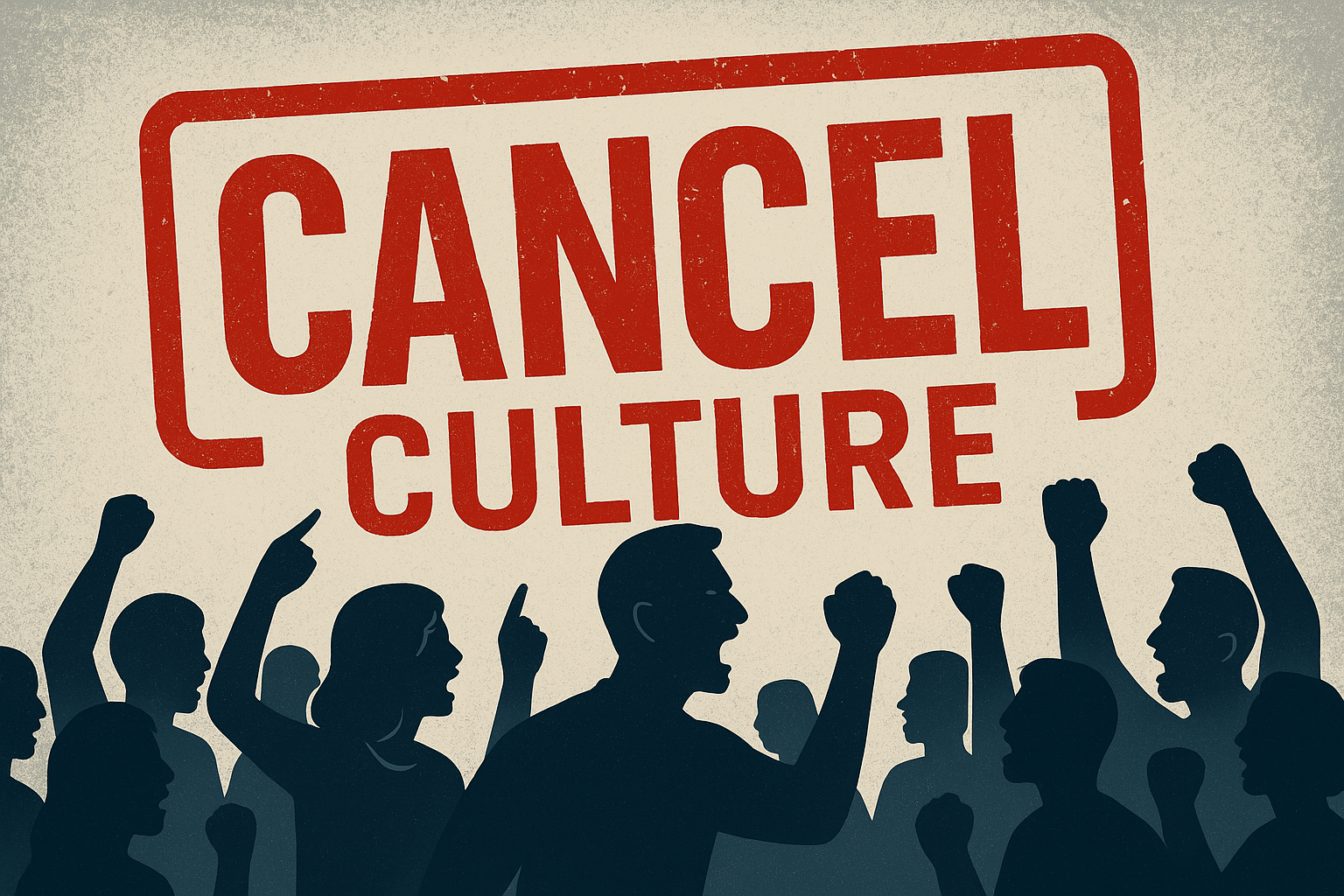
in recent years, cancel culture has emerged as a potent social phenomenon, fuelled by the immediacy and reach of social media. While it is defended by many as a tool of accountability—particularly for voices historically marginalised—it also raises grave concerns about free expression, proportionality, fairness, and the risk of mob justice. As exams loom, one wonders not only how to understand this phenomenon, but how to devise practical solutions—especially through social ventures or organisations—that can help preserve open discourse, protect individuals, and enhance civility.
The Nature and Risks of Cancel Culture
-
Definition & Dynamics: At its core, cancel culture refers to the social process in which individuals, works, or institutions are publicly repudiated, ostracised, or boycotted—often on social media—for perceived wrongdoing. The action may be justified, or may be disproportionate, or based on misunderstandings or decontextualised statements.
-
Impacts:
-
Silencing Effect: Fear of being cancelled may lead people to self-censor, withdrawing from public discourse.
-
Polarisation: Discourse becomes more binary; nuances, complexity, historical contexts are often lost.
-
Emotional, Psychological and Legal Harm: The targets of cancel campaigns may suffer threats, loss of livelihood, reputational damage—sometimes without clear recourse.
-
Erosion of Free Expression: Democracies rely on dissenting, even uncomfortable voices; if public space becomes one of conformity under threat, freedom of speech is compromised.
-
Existing Non-Profit and Civil-Society Interventions
A number of NGOs and initiatives already address related problems—hate speech, online harassment, digital violence, and protection of expression. Drawing on their missions can help us see what works and what gaps remain.
-
HateAid (Germany): Provides legal support and counselling for those subjected to online hate and digital violence. It also raises awareness, works with politics, media, and civil society to improve conditions for safe speech in digital space. HateAid+1
-
#IamHere / iamhere international: A social movement that promotes counter-speech (speaking up against hate and misinformation) on social media. Wikipedia
-
Right to Be (formerly Hollaback!): Focuses on ending harassment in all its forms via bystander intervention training, storytelling, grassroots work. Wikipedia
-
UNESCO, European Commission & EU Projects: For example, projects such as SELMA (Social and Emotional Learning for Mutual Awareness), #NoHateOnline, and efforts to improve media literacy. Better Internet for Kids+1
-
National Coalition Against Censorship (NCAC, USA): Advocates free expression, provides resources, helps people and institutions resist censorship. Wikipedia
These organisations help in various ways: legal support, awareness raising, policy advocacy, education, monitoring, counter-speech, etc.
Proposed Business/NGO Models & Entrepreneurial Solutions
In addition to existing work, there is room for novel social enterprises or non-profit models that more directly address the challenges of cancel culture. Below are some ideas, followed by example ventures or potential pilots.
| Model | Core Idea | Potential Activities / Services | Example or Pilot Suggestion |
|---|---|---|---|
| Digital Reputation & Restoration Agency | A service devoted to helping individuals who have been “cancelled”—especially when cancellations are based on misunderstandings or overreactions—to restore their reputation, publicly clarify, mediate, or even receive emotional/legal support. | • Mediation and dialogue facilitation between offended parties. • Reputation audits: helping clients understand what went wrong, what social norms were violated, whether apology or clarification would help. • PR / communication coaching; managing public statements. • Psychological counselling if harassment has taken toll. • Legal advice where defamation or illegal harassment is involved. |
A start-up could be created that operates globally, perhaps initially in English and Spanish, offering affordable services. It could partner with law firms, psychologists, PR experts. For example: “ReCivility Ltd.” or “RestoreVoice”. |
| Platform Tools for Healthy Discourse | Tools and platforms that help moderate, mediate, or structure online conversations to avoid snap judgments and mob dynamics. | • Social media plugins/filters that prompt users to think (e.g. “Are you sure this quote is in context?”) before sharing or commenting. • Delayed posting of incendiary content giving time for reflection. • Dashboards for content creators/journalists to track harassment and obtain help. • AI tools to detect context abuse (e.g. misquoted statements) or trained-nudges that encourage empathy. |
For instance, a SaaS platform that offers these tools to content creators, media outlets, universities. A pilot could be run with student journalists, or small publishers, offering “SafeSpeech Toolkit”. |
| Education / Literacy Enterprises | Teaching skills: media literacy, critical thinking, empathy, conflict resolution so that audiences judge more fairly, understand nuance, avoid jumping to cancellation. | • Workshops in schools, universities and companies. • Online courses on digital citizenship, ethics of outrage, history of defamation, etc. • Certifications in “Constructive Dialogue” or “Digital Civility”. • Public awareness campaigns, influencer partnerships. |
E.g. A “Digital Civility Academy”, offering online certificate programs; or NGO-business hybrid that contracts with schools or corporate clients to run monthly modules. |
| Legal Advocacy & Policy Organisations | Working to ensure legal protections for those unfairly harmed by cancel culture, preserving free expression rights, defining boundaries for what constitutes defamation / hate, etc. | • Assisting in drafting legislation or regulation for platform accountability. • Legal clinics offering free or low-cost advice to people caught in cancel campaigns. • Litigation when rights are violated (libel, defamation, wrongful dismissal). • Research and policy reports to shape public debate. |
A nonprofit legal centre could be created in Spain or Catalonia, offering a “Free Expression Defence Fund”. Could collaborate with universities, bar associations. |
| Platform Moderation & Social Media Ecosystem Services | Providing moderation services or consultancy to platforms to design better community guidelines, more transparent moderation, appeals processes. | • Auditing existing platform rules and their enforcement. • Designing transparent appeals for users who feel wrongly “cancelled”. • Training moderators in bias awareness. • Offering community-based oversight (e.g. panels) for content moderation. |
A company could offer consultancy to Spanish language platforms (or SMEs) to implement best moderation practice. Name example: “ModerateFair Consulting”. |
Challenges & Risks
Any solution must navigate several pitfalls:
-
Defining Fairness: What counts as “unfair cancellation” versus legitimate accountability is contested. Authority to judge must be carefully constructed to avoid bias.
-
Financial Viability: Services (e.g. legal aid, reputation management) may be costly; many potential clients may have limited means or fear exposure.
-
Scale & Reach: Cancel culture is global and often anonymous. Local projects may struggle to influence global social media dynamics.
-
Backlash & Perception: Entities helping those cancelled might themselves be accused of siding with at-odious opinions; the distinction between defending free speech and defending hate is delicate.
-
Avoiding New Censorship: In trying to constrain cancel culture, one must not create new forms of suppression—e.g. suppressing the right to point out genuine wrongdoing.
A Possible Case Study: “Free Discourse Alliance” (Hypothetical Pilot)
To illustrate how several of the above elements could be combined, consider a hypothetical venture: Free Discourse Alliance (FDA).
-
Mission: To preserve and rehabilitate open, honest public discourse; to protect individuals from unjust social ostracism due to misunderstandings or lack of due process; to promote civil disagreement.
-
Structure: Hybrid nonprofit / social enterprise. Revenue from consulting, workshops for companies/institutions; legal clinic funded by grants and sliding-scale fees.
-
Activities:
-
Restorative Dialogue Service: When somebody is criticised heavily online (especially over past statements), the FDA works with them and with affected parties to clarify context, possibly mediate an apology or explanation.
-
Safe-Expression Certification: Organisations (universities, media outlets, companies) can become certified for having clear, fair policies about free speech, grievance and appeals; a mark that signals commitment to due process.
-
Digital Awareness Education: Workshops for young people on media literacy, empathy, contrast between cancellation and accountability, how to evaluate sources, etc.
-
Legal & Mental Health Support: For those who have been subject to harassment, defamation or serious criticism, offering low or no-cost services, counselling.
-
Platform-Facing Advocacy: Working with social media companies to improve moderation transparency, appeals mechanisms, “cooling off” periods etc.
-
-
Outcomes to Measure: Number of people helped, instances of restored reputation, changes in behaviour of institutions with Safe-Expression Certification, reduction of online harassment in partner platforms, surveys of self-censorship.
Conclusion & Call to Action
Cancel culture reflects deep tensions in modern society: the urge for accountability versus the imperative of free speech; the speed of social media versus the slow work of knowledge, understanding and nuance. While some level of public disapproval is legitimate—and in many cases necessary—societies must guard against disproportionate reactions, unfair damage, and erosion of open discourse.
Entrepreneurs, NGOs, academics, and policy-makers have a shared opportunity: to design interventions that preserve dignity, fairness, and freedom. If you are pondering an entrepreneurial idea, or know institutions or donors interested, I encourage you to develop one of the models above—or combine them. Because preserving the space to err, to disagree, and to learn is indispensable for innovation, human flourishing, and democracy.
 @Yolanda Muriel


