The door creaked open.
The sound echoed through the abandoned corridor, too loud for a building that had once been the best school in the world. I hesitated before stepping inside. Something rustled in the darkness above me, a dry, secretive sound, as if the air itself were shifting to make space for my presence.
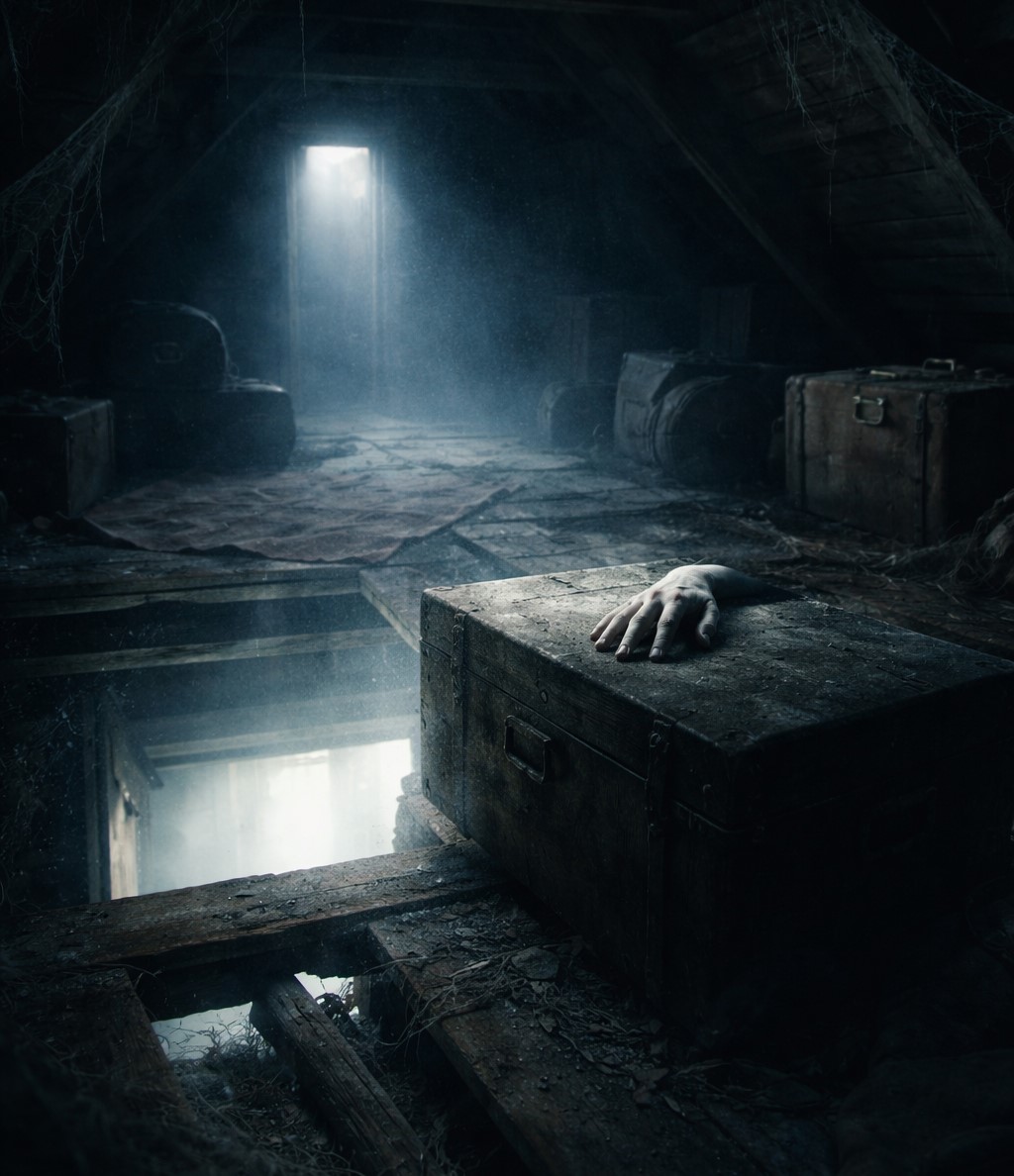
I stared, but I could see nothing beyond the vague shapes of old suitcases piled against the walls. The attic smelt damp, stale, and faintly sweet, like things forgotten for too long. I wedged the door open with my foot, and light poured into the darkness in a narrow, trembling blade.
The floor was unfinished. Exposed beams crossed the space like fragile ribs. I balanced upon them carefully, because I knew that if I stepped onto the plaster, I could fall straight into the classroom below. That room, they said, had been sealed after the last student disappeared.
A cobweb brushed my face. I flinched as I felt the sudden tickle of a spider crawling across my cheek. The air grew darker and colder the farther I moved from the door. Moth-eaten rugs lay folded in the corners, smelling sharply of mothballs. Thick dust powdered every surface, softening edges, swallowing time.
This was where the lesson was taught.
Not in classrooms. Not with books or screens. Here.
The school had once been famous. World leaders, innovators, and visionaries had walked its halls. The brochures spoke of excellence, discipline, and brilliance. But none of that explained why so many of its former students went on to become something else entirely: figures people followed without knowing why, voices that gathered attention effortlessly, faces that seemed to draw agreement out of thin air.
They said those students had won the White Hand.
No teacher ever explained how.
In the age of technology, there were no teachers for this lesson.
I moved deeper into the attic, my breath slow, deliberate. The silence pressed against my ears. Then I saw it.
A hand.
It rested on a wooden crate near the far wall. Quite still. White as marble. Perfectly clean, untouched by dust. At first, I thought it was a sculpture, some forgotten symbol left behind by a previous generation.
Then it moved.
Not suddenly. Not violently. One finger twitched, almost lazily, as if testing the air. I froze, my heart pounding so loudly I was certain it would give me away. The hand did not reach for me. It simply waited.
I understood then what the school never put into words.
Winning the White Hand was not about strength or intelligence. It was not about courage, either. It was about stepping forward without being told how. About choosing movement over instruction. Presence over permission.
The hand shifted again, turning slightly toward the light. I sensed—not heard, not saw—that it was measuring me. Weighing something invisible.
I took one more step along the beam. The wood creaked softly beneath my foot. Dust rose and hung in the air like breath.
Behind me, the darkness seemed to close in. Ahead of me, the hand remained still.
If I reached it, I would never be the same. If I turned back, I would leave empty-handed, and nothing in my life would ever truly follow me again.
So I reached out.
And the light went out.
The darkness did not feel empty.
It pressed against me, heavy with expectation. I sensed the hand before I saw it again, no longer white but luminous in its own way, as if it absorbed everything around it. The silence thickened, charged with a force that was neither sound nor thought, but something closer to gravity.
I understood then what winning meant.
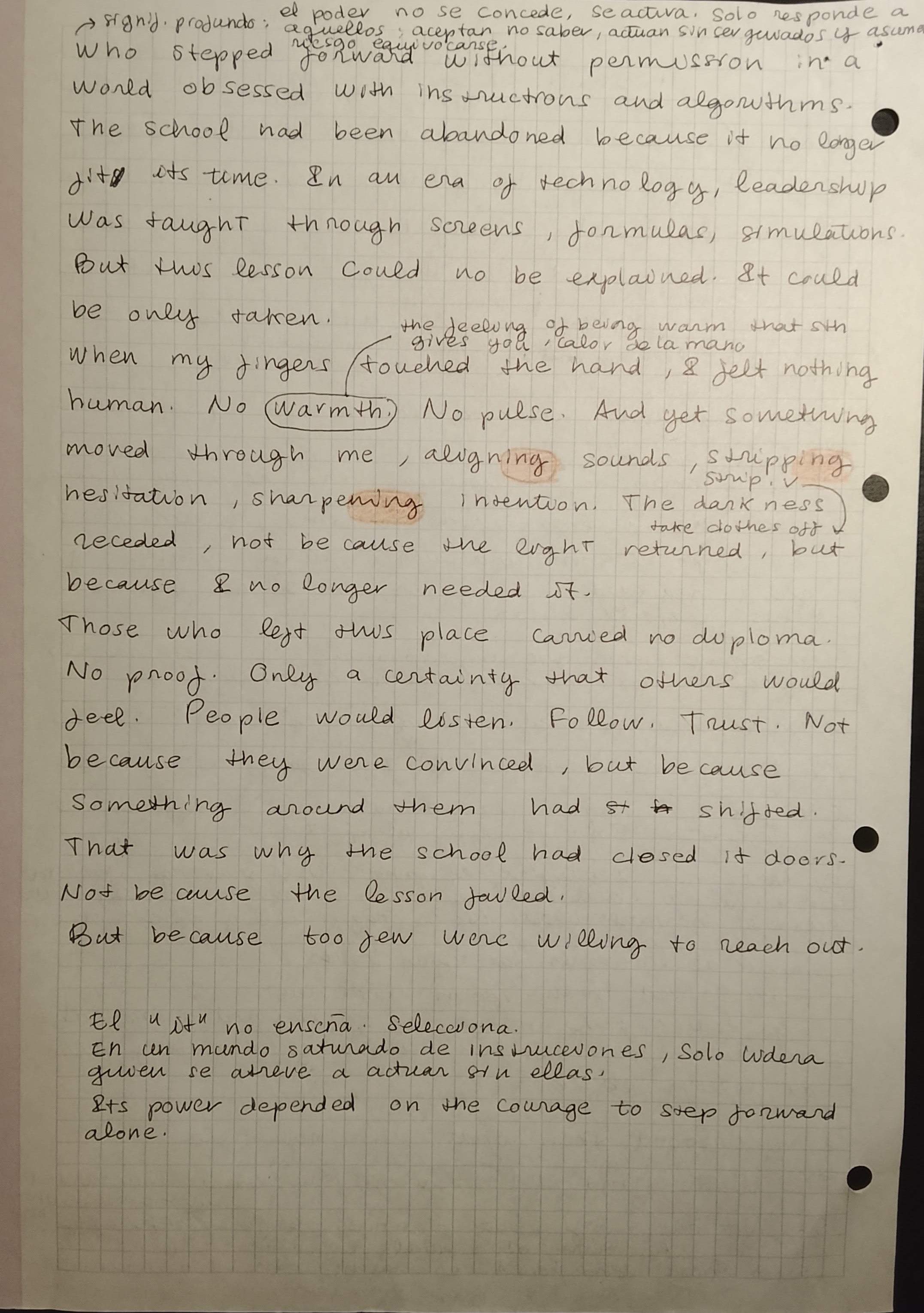
The White Hand did not grant power. It demanded it. Not authority, but presence. It drew energy from those who dared to reach without guidance, who stepped forward without permission in a world obsessed with instructions and algorithms.
The school had been abandoned because it no longer fit its time. In an era of technology, leadership was taught through screens, formulas, simulations. But this lesson could not be explained. It could only be taken.
When my fingers touched the hand, I felt nothing human. No warmth. No pulse. And yet something moved through me, aligning thoughts, stripping hesitation, sharpening intention. The darkness receded, not because the light returned, but because I no longer needed it.
Those who left this place carried no diploma. No proof. Only a certainty that others would feel. People would listen. Follow. Trust. Not because they were convinced, but because something around them had shifted.
That was why the school had closed its doors.
Not because the lesson failed.
But because too few were willing to reach out.
Bonus 1: see the video: Stephen King talks about his writing process.
Some crucial ideas of the video:
- The best description of writing a novel that I ever heard, it’s actually in Thomas Williams’s book, The hair of Harold Roux, which is about a novelist trying to write a novel and it just covers like one or two days in this process, and a lot of things happen to him. It’s a fabulous book but he says that writing a novel is like building a little campfire on an empty dark plane and one by one these characters come out of the dark, and each one has a little pile of wood and they put it on the fire, and if you’re very lucky before the fire goes out. It’s this big bonfire and all the characters stand around it and warm themselves and that’s the way it’s always been for me.
King’s quote: «Terror is what happens when you let the reader imagine.»
Bonus 2:Narrative Strategies used in this story Inspired by Stephen King
In this short story, I deliberately apply several narrative strategies commonly associated with Stephen King’s approach to suspense and psychological tension, adapting them to a scientific and contemporary context.
First, I prioritise sensory-driven narration over explicit explanation. Sound, texture, smell, and spatial perception play a central role in building unease. Instead of describing fear directly, I allow it to emerge through concrete sensations: creaking wood, rustling movement, thick dust, cold air, and restricted visibility. This technique invites the reader to participate actively, completing the scene with their own imagination.
Secondly, I employ restraint and omission as structural tools. Key elements—such as the true nature of the White Hand or the mechanism behind its power—are intentionally left undefined. Following King’s principle that terror weakens when overexplained, the narrative focuses on effects rather than causes, allowing ambiguity to sustain tension.
Another strategy is the use of the ordinary as a gateway to the uncanny. Familiar spaces—a school, an attic, discarded objects—are gradually destabilised. This transformation from the mundane to the unsettling reflects King’s belief that effective horror arises when the reader recognises the setting before it becomes threatening.
I also rely on rhythmic variation at sentence level. Short, abrupt sentences interrupt longer descriptive passages, controlling pace and emotional impact. This modulation mirrors moments of hesitation, realisation, or decision within the protagonist’s experience.
Finally, the story integrates metaphorical science rather than overt speculation. Concepts such as gravity, energy, and resonance are used symbolically to frame leadership and influence as forces that are felt rather than taught. In doing so, the narrative aligns with King’s tendency to ground the extraordinary in familiar conceptual frameworks, maintaining plausibility while preserving mystery.
Together, these strategies aim to create a narrative in which tension arises not from spectacle, but from proximity, suggestion, and the reader’s own interpretive engagement.
Food for thought:
Beyond his narrative techniques, Stephen King’s career itself stands as a powerful counterexample to the contemporary illusion of instant expertise. His recognition is not the result of sudden inspiration or superficial productivity, but of decades of disciplined, daily writing. King has often spoken openly about his routine, about showing up every day and doing the work, regardless of mood or inspiration. There is something profoundly instructive in the way he welcomes readers and interviewers from his own living room, seated on a sofa, wearing a simple sports T-shirt, speaking without performance or pretence. This humility is not a pose; it reflects a writer whose authority comes from practice rather than spectacle. In a cultural climate that increasingly suggests mastery can be achieved in five minutes, King’s trajectory reminds us that depth, craft, and genuine expertise are built slowly, through persistence, repetition, and an unglamorous commitment to the page.
His first novel, Carrie, was published in 1974, so as of 2026 he has been writing professionally for about 52 years.
To my readers: when excellence is shaped by years of discipline, practice, and sustained commitment, how quickly can such depth truly be reached? That is, can excellence exist independently of time, or is time itself an essential ingredient of mastery? Stephen King’s career quietly suggests that excellence is rarely accidental; it is the result of time, persistence, and an unwavering commitment to the craft.
Bonus 3: My handwritten story with comments about different strategies.
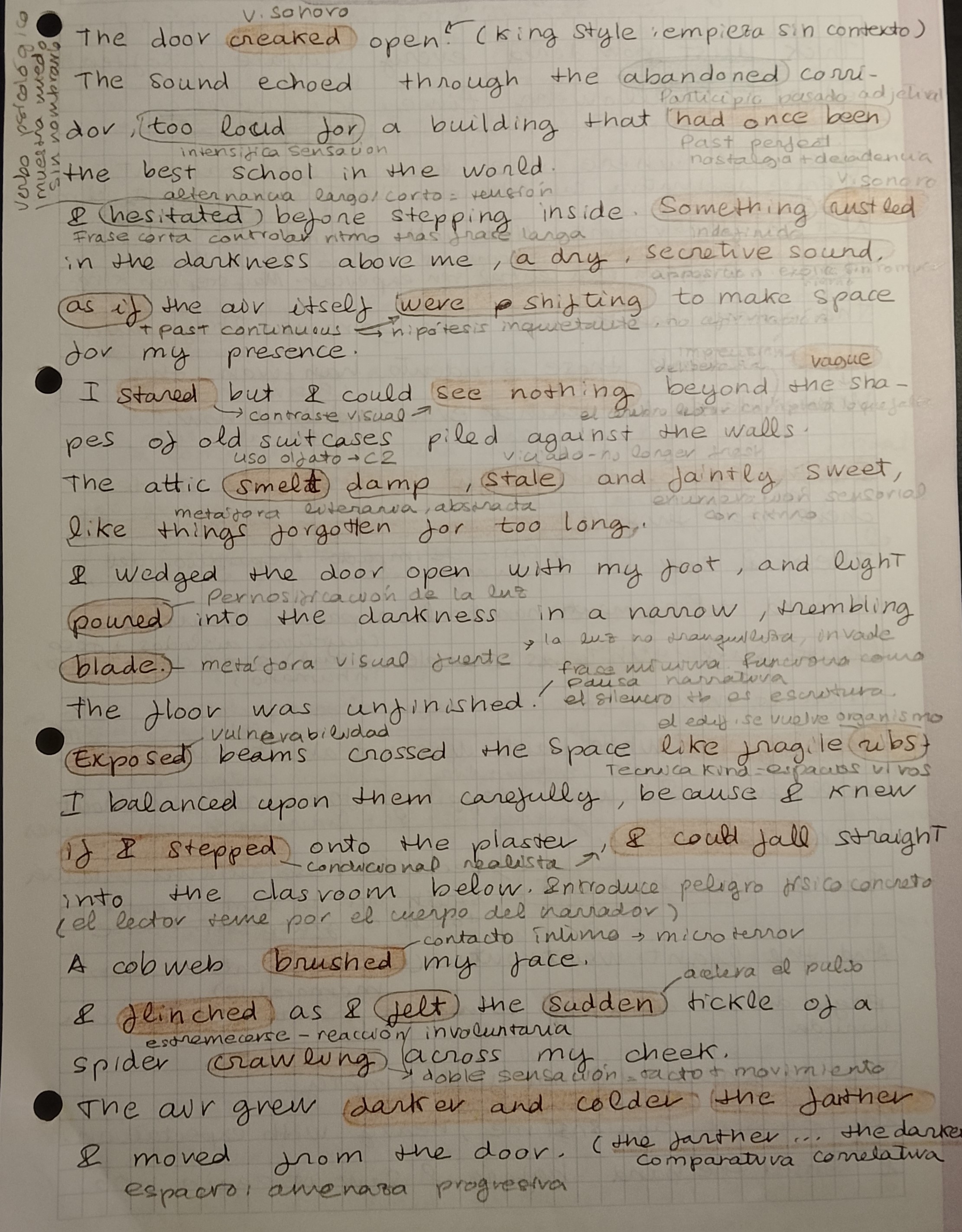
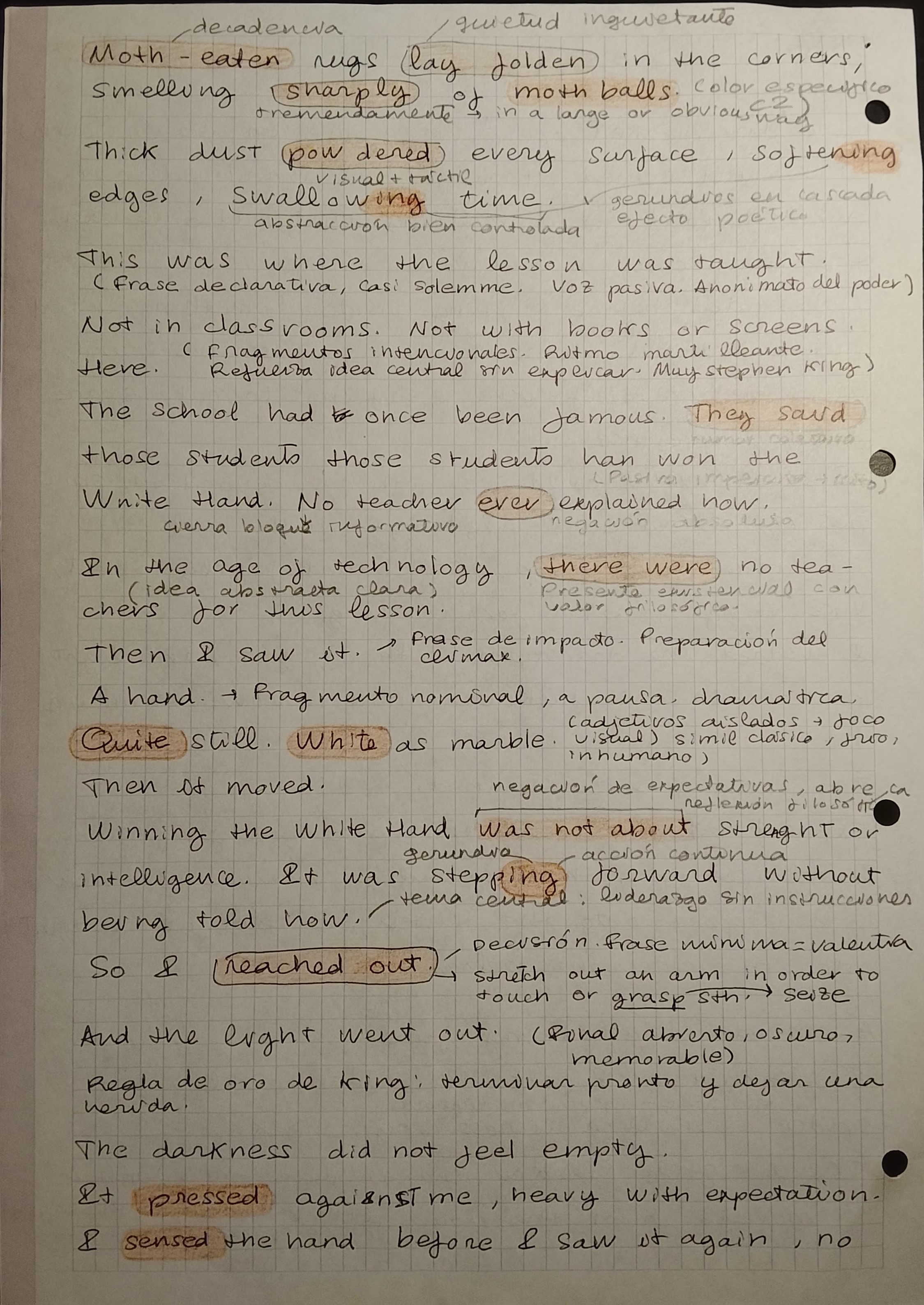
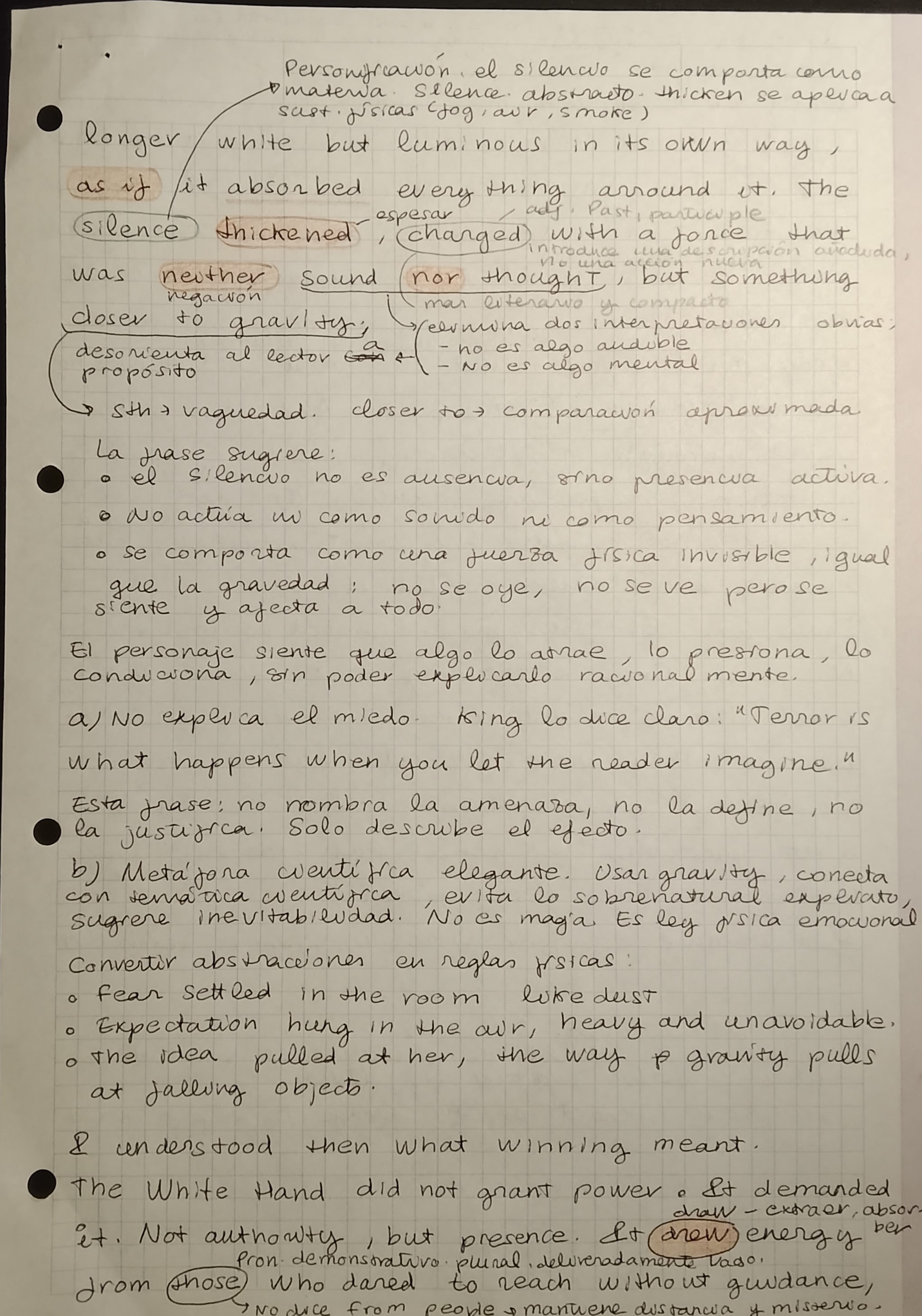
 @Yolanda Muriel


