Why Time Matters
Time is a very important part of how humans think and act. Many human activities, especially language, happen in a sequence. We speak word by word, listen over time, and understand meaning as information unfolds. Because of this, the human brain must have some way to deal with time.
Without time, it would be hard to explain basic things like planning, goal-directed behavior, or understanding cause and effect. For this reason, researchers want to understand how time is represented in the mind, especially in models that try to imitate human thinking.
The Problem with Representing Time
One big challenge is that time is naturally sequential, meaning things happen one after another. However, many computer models of thinking work in a parallel way, where many things are processed at the same time. This creates a problem:
How can a parallel system understand something that happens step by step?
A common solution has been to represent time as if it were space, for example by placing events in different positions. However, this solution is not very good, because time is not really like space.
A Different Idea: Time as Change
Instead of representing time directly, there is a different approach:
Do not represent time as a separate thing. Represent it through its effects.
In this approach:
- Time is not added as a special dimension.
- Time is shown through changes in internal states of the system.
- What matters is how previous information influences current processing.
This idea comes from using recurrent neural networks, which are systems that can feed information back into themselves. This allows them to have a kind of memory.
Memory and Context
In these models, memory is not stored in a fixed location. Instead:
- Memory is created by ongoing activity.
- Past experiences influence how new information is processed.
- Task demands and memory are tightly connected.
Because of this, the system can behave differently depending on the context, even if the input looks similar. This helps explain why humans are very flexible in understanding language and meaning.
Why This Is Important for Language
Language is a perfect example of something that depends on time. Words only make sense in relation to the words that come before them. This model shows how:
- Meaning can grow over time.
- Categories in language can be learned from experience.
- General rules can appear even without explicit symbols or grammar rules.
This challenges the idea that language understanding must always rely on strict symbolic structures.
References:
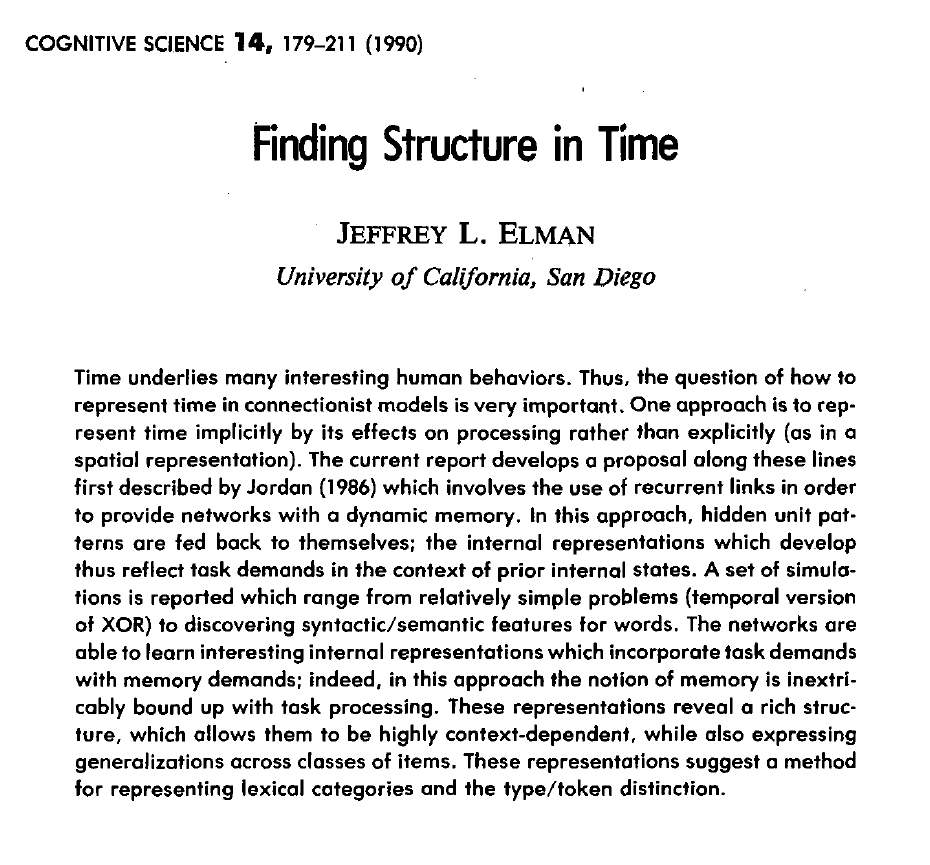
Finding structure in time. Jeffrey L. Elman
 @Yolanda Muriel Attribution-NonCommercial-NoDerivs 3.0 Unported (CC BY-NC-ND 3.0)


 yolandamuriel.com