Introduction
Video understanding has become a central problem in computer vision, requiring models that can process both spatial information (what is in each frame) and temporal dynamics (how things change over time). Modern deep learning approaches often combine Convolutional Neural Networks (CNNs) with temporal modeling techniques such as Recurrent Neural Networks (RNNs), while also addressing efficiency challenges through architectural design choices.
This article summarizes key concepts in video processing architectures, including temporal modeling, parameter efficiency, motion representation, and evaluation metrics.
CNN + RNN vs. Average Pooling Approaches
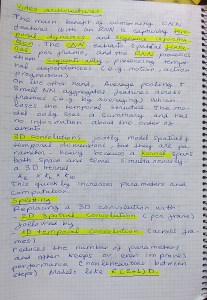
A common baseline for video processing is extracting features from individual frames and applying average pooling across time, followed by a small neural network. While simple and efficient, this approach has a critical limitation: it loses temporal ordering, treating all frames equally. In contrast, combining CNNs with RNNs provides a powerful alternative: CNNs extract spatial features frame by frame, and RNNs process these features sequentially, capturing temporal dependencies, so RNNs are aware of temporal ordering.
This enables the model to understand motion patterns, action progression, and temporal context—essential for tasks like action recognition and video classification.
Reducing Parameters in 3D Convolutions
3D convolutions extend standard 2D convolutions by incorporating the time dimension. While effective, they are computationally expensive due to large kernel sizes. A widely used technique to reduce parameters without sacrificing performance is: Factorizing 3D convolutions into 2D (spatial) + 1D (temporal) convolutions. The benefits are fewer parameters, reduced computational cost and improved optimization due to intermediate nonlinearities.
This idea is implemented in architectures such as R(2+1)D, which often outperform standard 3D CNNs despite being more efficient.
Efficient Temporal Processing with SkipRNN
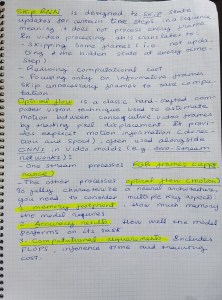
Processing every frame in a video can be redundant and computationally expensive. SkipRNN addresses this by learning when to update its hidden state: skip uninformative frames and focus only on important temporal events. SkipRNN reduces computation by selectively skipping frames. This makes it particularly useful for long video sequences where many frames contain redundant information.
Incorporating Motion: Optical Flow
In addition to appearance, understanding motion is crucial for video analysis. A popular hand-crafted technique used in deep learning pipelines is: Optical Flow. It Estimates pixel-wise motion between consecutive frames and provides direction and magnitude of movement. They are often used in two-stream architectures:
- One stream processes RGB frames (appearance).
- Another processes optical flow (motion).
Optical flow remains a strong baseline for encoding motion, even in deep learning systems.
Fully Characterizing a Neural Architecture
When designing or evaluating a neural network, it is not sufficient to consider only performance. A complete characterization includes:
1. Accuracy
- Measures how well the model performs on a task.
2. Memory Footprint
- Includes model parameters and intermediate activations.
- Critical for deployment on constrained hardware.
3. Computational Requirements
- FLOPs, inference time, and training cost.
- Important for scalability and real-time applications.
Conclusion
Modern video processing systems require a careful balance between accuracy, efficiency, and temporal modeling. Key insights include:
- RNNs capture temporal structure, outperforming simple pooling strategies.
- Factorizing 3D convolutions improves efficiency without sacrificing performance.
- SkipRNN reduces redundant computation by skipping unnecessary frames.
- Optical flow provides a powerful hand-crafted motion representation.
- A complete evaluation must include accuracy, memory, and computational cost.
Together, these principles form the foundation for designing efficient and effective video understanding architectures in deep learning.
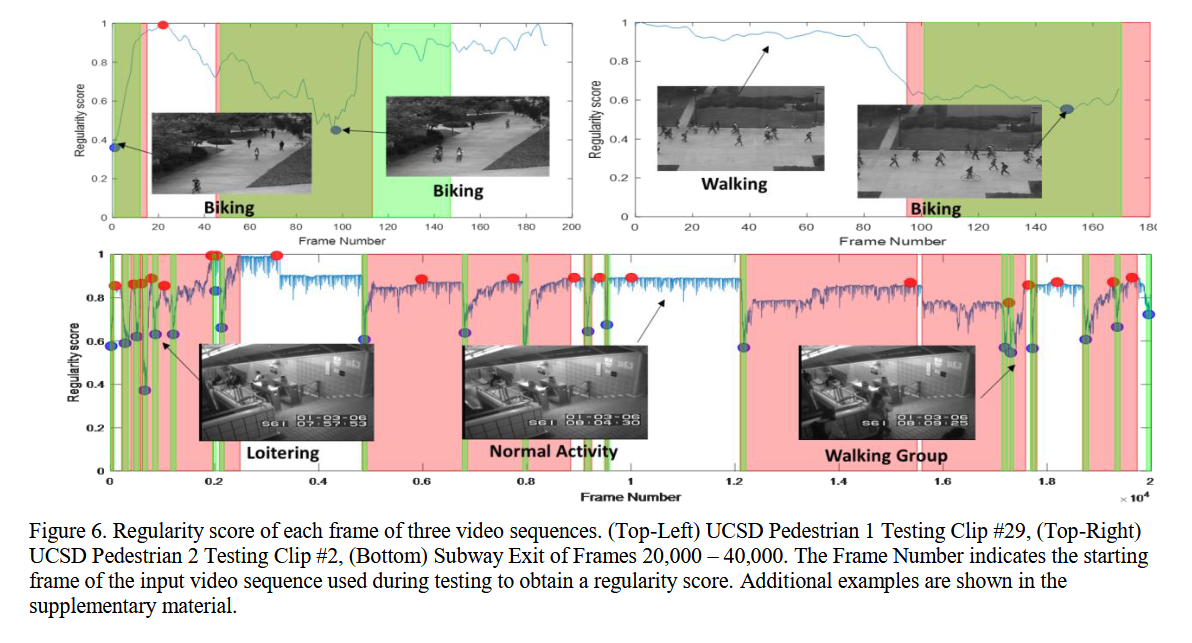
© Image. Article: Anomaly Detection in Video Using Predictive Convolutional Long Short-Term Memory Networks.
Bonus
Write down your ideas.
 @Yolanda Muriel

 yolandamuriel.com