Fine-tuning is the process of continuing to train a pre-trained language model on a single, specific task so that it becomes highly specialized at that task. They works using this workflow:
- A model is first pre-trained on large amounts of general text (books, articles, web data).
- Then, it is trained again on a task-specific dataset.
- During this second phase, the model’s parameters are adjusted to optimize performance for that one task.
Example
- Fine-tuning BERT for Question Answering
- The training data might consist only of:
- A question
- A paragraph
- The correct answer span
Key characteristics High performance on one task, poor generalization to other tasks, requires a new fine-tuning process for every new task, and needs labeled data for each task.
Typical use cases
- Sentiment analysis.
- Named entity recognition.
- Document classification.
- Question answering systems trained for a fixed domain.
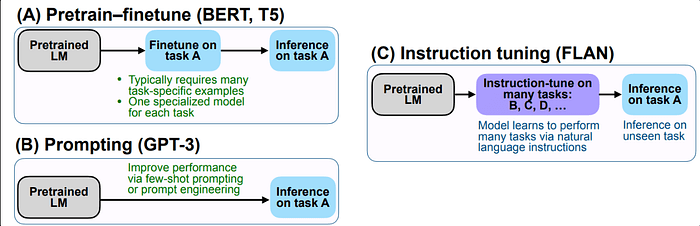
Source: Image from Google Research Paper
Instruction Fine-Tuning
Instruction fine-tuning is a more recent approach where a pre-trained model is trained on a large and diverse set of tasks, each expressed as a natural language instruction. The goal is to teach the model to:
“Understand what the user wants just from the instruction.”
The model is trained on many datasets, each framed as an instruction and each training example includes:
- A task description (instruction).
- An input (optional).
- The desired output.
Example
Instruction: Translate the following sentence into Spanish.
Input: "Good morning"
Output: "Buenos días"
The same model might also see: Summarization tasks, reasoning problems, classification tasks and code generation task
“The objective is to create a model that is able to perform any task just from its description.”
That means: The model does not need retraining for new tasks, and it can generalize to tasks it has never seen before, as long as they are described clearly.
Core Differences
| Aspect | Fine-Tuning | Instruction Fine-Tuning |
|---|---|---|
| Task scope | One specific task | Many different tasks |
| Training data | Task-specific | Multi-task, instruction-based |
| Flexibility | Low | High |
| Generalization | Narrow | Broad |
| New task support | Requires retraining | No retraining needed |
| Interaction style | Fixed input format | Natural language instructions |
Instruction fine-tuning is what enables modern large language models to behave like general-purpose assistants.
Because of instruction fine-tuning, models can: Answer questions, write summaries, translate text, solve math problems, and follow multi-step requests—all without being explicitly retrained for each capability.
This is the foundation of systems like:
- Chat-based AI assistants.
- Copilots.
- Multi-purpose foundation models
Instruction fine-tuning works together with prompting techniques: Zero-shot prompting, Few-shot prompting and Chain-of-thought prompting.
Because the model has been trained to follow instructions, it can: Understand the intent of prompts, adapt behavior based on task descriptions and perform reasoning when asked explicitly.
Without instruction fine-tuning, many prompting techniques would be far less effective.
Summary
- Fine-tuning makes a model excellent at one specific task.
- Instruction fine-tuning makes a model good at many tasks by learning to follow instructions.
- Instruction fine-tuning is what turns a language model into a flexible, interactive assistant.
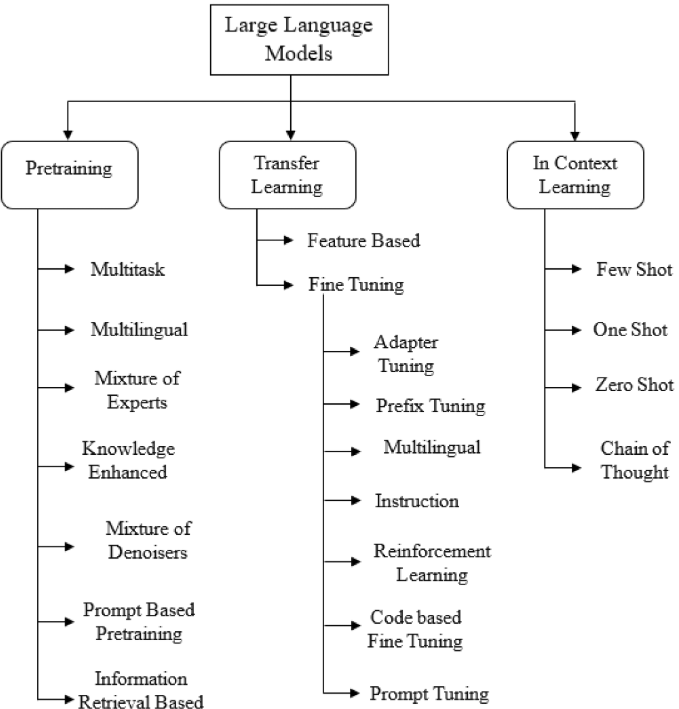
©Image. Source: Image from MDPI
Bonus
Write down your ideas.
 @Yolanda Muriel


