The Neon Demon is a psychological horror film directed by Nicolas Winding Refn that symbolize the performative vampirism of the real world. The film speaks the language of counterculture and it incorporates some Lynch-style surrealism. Who cares about human damage, as long as it looks good?
Everywhere, people fall for the beauty of the main character, Jesse. Three women—two blonde vamps (Gigi and Sarah) and Ruby, will stop at nothing to get rid of her, even resorting to cannibalism. Soon, other models in Los Angeles become jealous of Jesse’s beauty and vitality, and the rest of the fashion industry envies her vibrancy (likened to “the sun,” as a vampiric model literally tells her). In other words, the models resent how the industry’s power players (bigwigs) revolve around her, so they want her gone. Ultimately, they kill her in order to become her.
The Neon Demon holds up a mirror to our world, and arguably, to our professional environments as well. Jesse’s uniqueness is precisely what makes her vulnerable; being exceptional is closely tied to danger, so people like her must remain alert. But she doesn’t. She fails to stay vigilant.
Refn’s Neon Demon manifests in many forms (a mountain lion that enters Jesse’s motel room when she leaves the door open…), but we glimpse it in its purest form during the fashion show. As Jesse walks, she approaches three hovering neon triangles that appear almost like a vision. When she reaches them, she looks up and sees three reflections of herself. The triangles evoke a satanic symbolism associated with the Neon Demon—it mirrors the three predatory women and, more broadly, the darker forces embodied by people in the world.
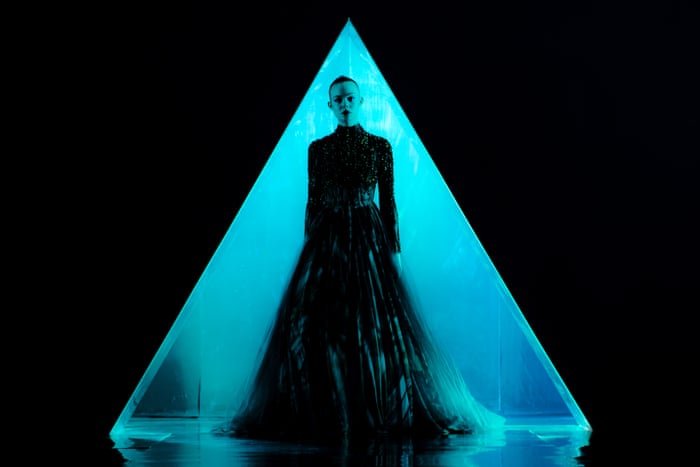
The white triangle is inspired by the work of the architect James Turrel whose works are like sacred spaces. That reference gave the triangle a touch of the spiritual.

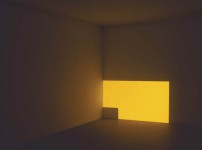
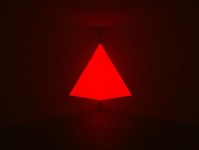
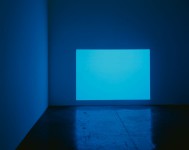
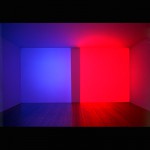

© Images: James Turrel.
The colour blue had a lot to do with the Greek myth Narcissus. Then it’s going to transform into red and go from the Alice in Wonderland to the empowered beauty girl. It’s done with just light and mirrors.
Nicolas, the director of the film, although Danish, he spent his adolescence in New York with his filmmaker parents. The Neon Damon is his 10th movie.
Refn makes the familiar feel new to us. His approach is designed to unsettle and disorient the mind. One unconventional aspect of his method is his insistence on filming in the same order in which the story unfolds on screen. In Hollywood, this is often seen as impractical and costly, but Refn has worked this way since his debut in Copenhagen in 1996. For him, it allows the film to evolve organically as it progresses, an approach that aligns with his increasingly sparse use of dialogue.
The color red signifies danger, and it appears in every scene involving Jena Malone’s Ruby.
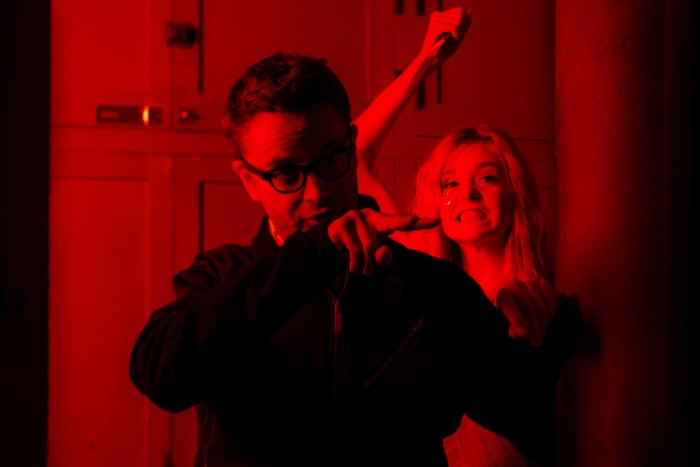
© Image: https://www.zonazhero.es/
Most of the time, the camera remains static. Refn wanted the film to feel like flipping through a photography book. He was drawn to telling the story within the composition of a single shot, cutting as little as possible. This approach allows the audience to fill in the gaps left to the imagination, something he finds this far more compelling than conventional narrative storytelling. It becomes a kind of visual poetry.
As an artist, it is interesting to commit to a single direction and push it to an extreme. In this sense, the film plays a kind of game: “Is this a murder scene? Is it really?” It constantly subverts expectations. Someone is photographing her, and we are unsure whether he has just killed her or is documenting a crime scene. Then, as the camera slowly pulls back with a dolly shot, it is revealed to be a photography set.

© Image: http://cannessoundtrack.com/cliff-martinez-best-compositor-of-cannes-soundtrack-2016/
 Contenido Web de Yolanda Muriel está sujeto bajo Licencia Creative Commons Atribución-NoComercial-SinDerivadas 3.0 Unported.
Note:
The specific details of the film have been obtained from authors who have written about this film (Internet source)


