The development of modern large language models represents one of the most significant technological advancements in artificial intelligence, combining innovations in neural network architecture, massive-scale computation, and human-guided alignment techniques.
At the core of these systems lies the Transformer architecture, specifically the decoder-only variant, which has become the dominant design for state-of-the-art language models. Unlike earlier sequence-to-sequence frameworks, decoder-only Transformers operate with causal attention, meaning that each token in a sequence can only attend to previously generated tokens. This constraint allows the model to generate coherent text step by step, predicting each new word based entirely on the context that precedes iT.
Within this architectural paradigm, two major approaches have emerged: dense models and sparse models.
Dense models activate all their parameters for every input, ensuring that the entire neural network contributes to each prediction. While this approach is straightforward and effective, it comes with a substantial computational cost, as every neuron in the network must be evaluated for each token processed.
In contrast, sparse models introduce a more efficient mechanism through Mixture of Experts (MoE) architectures. In these systems, the model is composed of multiple specialized sub-networks, known as experts, but only a subset of them is activated for any given token. This dynamic routing mechanism allows different tokens to be processed by different experts depending on their content, significantly reducing computational requirements while preserving model capacity. As a result, sparse models enable the construction of extremely large systems without a proportional increase in computational expense.
However, architectural innovation alone is insufficient to train such models. The scale of modern language models necessitates distributed computing across thousands of accelerators, such as GPUs or TPUs. A single device typically offers tens of gigabytes of memory, whereas large models require several terabytes to store their parameters and intermediate activations.
To address this limitation, multiple forms of parallelism are employed simultaneously.
Data parallelism replicates the model across devices, allowing each unit to process different batches of data before combining gradients.
Tensor parallelism divides the model’s internal computations, such as matrix multiplications, across multiple devices.
Context parallelism splits input sequences so that different devices handle different segments of long contexts.
Pipeline parallelism distributes layers of the model across devices, creating an assembly line where each stage processes a portion of the computation.
These strategies are often combined in practice, forming highly complex training systems capable of handling trillions of tokens and immense computational workloads.
The scale of these operations is extraordinary. Training cutting-edge models can involve tens of thousands of GPUs, processing trillions of tokens and consuming vast amounts of computational power measured in exaFLOPs. Such large-scale systems also face significant operational challenges. Hardware faults, memory failures, software bugs, and network issues frequently interrupt training runs that can last for weeks. In practice, the majority of failures are hardware-related, highlighting that building large language models is as much an engineering challenge as it is a scientific one.
Once a model has been pretrained on large corpora of text, it must undergo additional refinement to become useful in real-world applications. This is where instruction fine-tuning plays a crucial role. Unlike pretraining, which focuses on general language modeling, instruction fine-tuning trains the model to produce appropriate responses to specific prompts. The training process emphasizes the response portion of each example, masking the prompt so that the model is optimized only on the quality of its outputs. Although the dataset used at this stage is much smaller than in pretraining, it is carefully curated to include high-quality examples across a wide range of tasks, including general conversation, mathematical reasoning, programming, and tool usage. The training is conducted with lower learning rates and fewer epochs to ensure that the model retains its previously learned knowledge while adapting to new objectives. Increasingly, this process relies on a combination of human-generated and synthetic data, allowing for greater scalability in producing diverse training examples.
Despite these improvements, instruction fine-tuning alone does not fully align a model with human preferences. Humans often struggle to provide consistent numerical ratings for model outputs, making it difficult to directly optimize for quality. To overcome this limitation, preference fine-tuning introduces the concept of a reward model. Instead of assigning absolute scores, humans are asked to compare pairs of responses and select the one they prefer. This pairwise comparison framework is more intuitive and reliable, enabling the collection of high-quality preference data. The reward model is then trained to predict these preferences, learning to assign higher scores to favored responses than to rejected ones. Architecturally, the reward model is similar to the original language model but includes a scalar output head that produces a single score for each prompt-response pair. Through this process, the system effectively learns to act as a proxy for human judgment.
The final stage in this pipeline is reinforcement learning from human feedback, commonly referred to as RLHF. This process integrates the pretrained model, the instruction-tuned model, and the reward model into a unified optimization loop. Initially, the model is trained using supervised fine-tuning, learning to imitate high-quality human responses. Next, the reward model is trained on ranked outputs, capturing human preferences. Finally, reinforcement learning techniques, such as Proximal Policy Optimization (PPO), are used to further refine the model. In this stage, the model generates responses to prompts, the reward model evaluates these outputs, and the resulting scores are used to update the model’s parameters. Over time, this feedback loop encourages the model to produce outputs that maximize human satisfaction, effectively aligning its behavior with user expectations.
This multi-stage process transforms a general-purpose language model into a highly capable and aligned assistant. What begins as a system that predicts the next word evolves into a sophisticated tool that can follow instructions, reason through complex problems, generate code, and interact with external systems. The combination of advanced architectures, large-scale distributed training, and human-centered alignment techniques has enabled the rapid progress seen in modern AI systems. As these models continue to grow in size and capability, the interplay between computational efficiency, data quality, and alignment mechanisms will remain central to their development, shaping the future of artificial intelligence in profound and far-reaching ways.
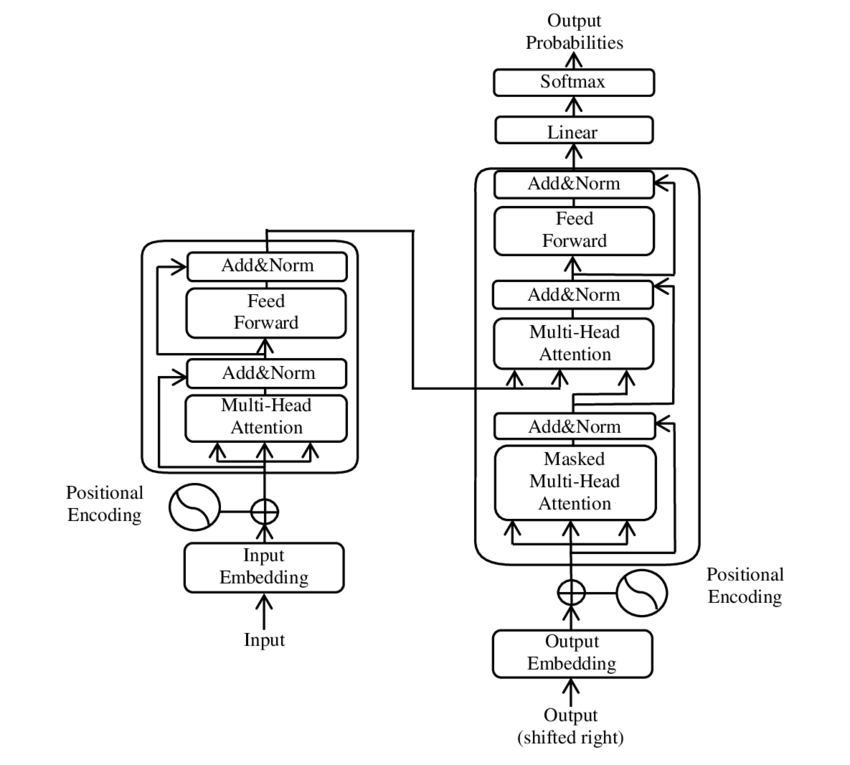
© Image. https://en.wikipedia.org/wiki/Large_language_model. An illustration of the main components of the transformer model from the original paper, where layers were normalized after (instead of before) multiheaded attention.




 @Yolanda Muriel


