Innovation as a Network of Knowledge We Don’t Yet Know We Are Building
In his 2005 Stanford commencement address, Steve Jobs told a story that offers an interesting perspective on innovation. He called it Connecting the Dots. After dropping out of Reed College, Jobs continued attending classes that genuinely interested him. One of them was calligraphy. He became fascinated by typography, typefaces, letter spacing and the artistic details of written communication. At the time, he had no idea how this knowledge might be useful in his future. But ten years later, when Apple was developing the first Macintosh, the knowledge he had acquired out of curiosity helped shape the computer’s typography and contributed to one of its distinctive features.
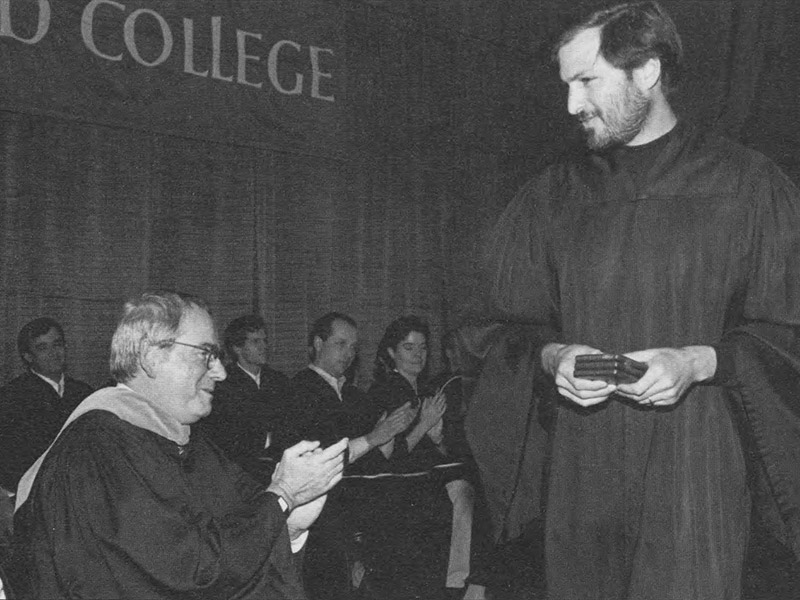
© Image. Reed College. In 1991, Steve Jobs was given the Vollum Award for Distinguished Accomplishment in Science and Technology.
Jobs explained that he could not have connected those dots looking forward. The connection only became clear when he looked backwards. We cannot connect the dots we haven’t created, but we also cannot know in advance which dots will matter.
Innovation requires building an invisible network of knowledge and experience long before we understand what it might lead to. It involves exploring different subjects, researching parallel fields, developing skills and pursuing questions whose practical value may not be immediately apparent. This is why innovation cannot always be planned as a linear process. It often emerges at the intersection of disciplines, experiences and ideas that are not normally brought together. The deeper and more diverse our explorations, the greater our ability to recognise relationships that others may not see.
This perspective has four dimensions:
1. We are not building isolated dots, but an invisible network. Every experience, research project or learning process can create connections for the future. However, these connections do not necessarily exist from the beginning. They gradually take shape as we explore other fields, develop new skills and accumulate experiences. Knowledge may remain apparently disconnected for years until something else emerges and gives it a different meaning.
2. Innovation requires parallel exploration, not just specialisation. Developing deep expertise in one field is important, but so is exploring other areas. In fact, innovation can emerge precisely at the intersection of different bodies of knowledge that would normally remain separate. The more fields we explore and the more deeply we work within them, the greater our ability to recognise relationships that are not immediately obvious.
3. The real challenge is that we cannot anticipate what knowledge we will need. This is, to me, the most interesting point. If we only study what we already know we will need to solve a specific problem, our possibilities will be limited by our current understanding of that problem.
Some of the most valuable connections come from knowledge acquired without any clearly defined practical objective.
In other words, we cannot justify all learning in terms of its immediate usefulness.
4. Innovation is not just about having ideas, but about developing the ability to recognise connections. Two people may have access to similar information and yet reach completely different conclusions. The difference may lie in their previous experiences, the diversity of their knowledge and their ability to identify relationships that others do not perceive. Having access to information is not the same as knowing how to connect it or recognise its potential.
Innovation requires us to build a network of knowledge and experience before we know which problem it will eventually help us solve. Work that may seem to lead nowhere at first could be precisely what makes it possible, years later, to discover a connection that changes things. This also leads to a business question that is Are companies genuinely investing in innovation, or are they only funding activities whose usefulness they already know how to explain? Perhaps the real challenge is to accept that some of the most valuable work cannot be justified by an immediate result. Its importance may only become visible when, much later, an unexpected connection finally appears.
Innovation is not just the art of connecting the dots. It is the patient work of building a network of knowledge without knowing, at first, what it will eventually make possible.
References
1. Steve Jobs — Stanford Commencement Address (June 12, 2005).
The original speech, particularly the first story, Connecting the Dots.
2. D’Este, P., Marzucchi, A. & Rentocchini, F. (2018). “Exploring and yet failing less: Learning from past and current exploration in R&D.”
Industrial and Corporate Change, 27(3), 525–553. Particularly relevant to the value of exploration, experimentation and accumulated experience, even when outcomes are uncertain.
3. Rhoten, D., O’Connor, E. & Hackett, E. J. (2009). “The Act of Collaborative Creation and the Art of Integrative Creativity: Originality, Disciplinarity and Interdisciplinarity.”
The Journal of Architecture, 96(1). Explores how original ideas can emerge at the intersection of different disciplines and through the integration of different perspectives.
4. Fleming, L. (2001). “Recombinant Uncertainty in Technological Search.”
Management Science, 47(1), 117–132.
5. Article. Steve Jobs and Reed College
 @Yolanda Muriel


